Fritz Hut | Thoughts & Commentary

Art, culture, and the conversations that matter.

Archives (page 10 of 11)

The Unraveling Thread: How Tarkovsky’s Mirror Predicted Today’s TikTok Cinema

The Algorithm of Memory

Andrei Tarkovsky’s 1975 masterpiece Mirror operates like a fever dream caught in amber. Fragments of childhood blur with historical footage. Personal memory collides with collective trauma. The film refuses linear narrative in favor of something more primal: the way consciousness actually moves through time.

Now watch a carefully curated TikTok feed. Notice how each 15-second clip bleeds into the next. A cooking video morphs into war footage, then pivots to someone’s childhood bedroom tour. The algorithm doesn’t follow plot logic. It follows emotional resonance, creating meaning through juxtaposition rather than causality.

Both forms understand something fundamental about how we process reality. Memory isn’t chronological. Neither is meaning. Tarkovsky spent decades crafting what TikTok now delivers in microseconds: the sensation of consciousness itself, unfiltered and associative.

The difference isn’t just temporal. Where Mirror asks us to sit with discomfort until understanding emerges, TikTok offers instant gratification followed by immediate displacement. But the underlying mechanism is identical: meaning through collision, not continuation.

Democratization or Dilution

Tarkovsky famously declared cinema “an art form that came into being to express time.” His films demand patience, contemplation, surrender to rhythms that mirror internal rather than external clocks. Each image burns slowly into memory, accumulating weight through repetition and variation.

Today’s micro-cinema operates on opposite principles while achieving similar effects. A teenager in Ohio creates a 30-second film about depression using nothing but bathroom mirrors and ring lights. The technique is crude. The emotional impact devastates. Millions view it within hours.

This democratization terrifies traditionalists, and I get it. When anyone can make “cinema,” does the term lose meaning? But consider this: Mirror itself was revolutionary precisely because it abandoned conventional filmmaking rules. Tarkovsky faced similar accusations of pretension, incoherence, self-indulgence.

The real question isn’t whether TikTok cinema is legitimate art. It’s whether we’re witnessing the birth of something entirely new: collective consciousness as medium, algorithmic curation as auteur theory, viral spread as distribution model.

Time as Material

Tarkovsky sculpted time like Rodin sculpted marble. His famous “pressure cooker” metaphor described how he compressed emotional intensity into extended moments, creating meaning through duration rather than information density. A single shot might last five minutes, forcing viewers to inhabit discomfort until revelation arrives.

Contemporary experimental filmmakers like Apichatpong Weerasethakul still work in this tradition. His films unfold like dreams, where normal time dissolves and moments stretch beyond logic. But they remain theatrical experiences, requiring dedicated attention in darkened rooms.

TikTok reverses this dynamic entirely. Instead of stretching time, it compresses everything into hyperkinetic fragments. Yet somehow this compression creates its own form of temporal dislocation. Hours disappear in seemingly seconds. Users report losing entire afternoons to the endless scroll.

Both approaches manipulate our perception of duration to create altered states of consciousness. Tarkovsky used expansion, TikTok uses acceleration. The neurological effect is remarkably similar: reality temporarily dissolves, replaced by something more fluid and associative.

The Persistence of Authenticity

Mirror worked because it felt genuinely personal despite its experimental structure. Tarkovsky drew from his own childhood, his mother’s experiences, his country’s historical trauma. The formal innovation served emotional truth, not intellectual exercise.

This authenticity paradox haunts contemporary micro-cinema. The most successful TikTok films feel intensely personal while being completely performed. Users craft elaborate personas, curate “authentic” moments, manufacture spontaneity. Yet something genuine emerges from this artifice.

Perhaps authenticity was always performative. Tarkovsky constructed his childhood memories as carefully as any TikTok creator constructs their daily routine. The difference is transparency. Where Tarkovsky hid his craft behind artistic mystique, TikTok creators openly acknowledge the performance.

This transparency might actually enable deeper truth-telling. When everyone admits they’re performing, the pressure to maintain illusions diminishes. Raw vulnerability becomes another aesthetic choice, not a confession of failure.

Beyond the False Binary

Critics love positioning these forms as opposites: contemplative versus hyperactive, artistic versus commercial, meaningful versus mindless. But this binary thinking misses the real story unfolding before us.

Experimental cinema has always been about pushing boundaries, questioning assumptions, finding new ways to represent consciousness. TikTok does exactly this, just through different means. It’s not the death of cinema but its evolution into something we don’t yet fully understand.

The most interesting contemporary artists already recognize this. Filmmakers like Ari Aster incorporate TikTok’s quick-cut aesthetics into feature films. TikTok creators experiment with longer-form storytelling. The boundaries blur because they were always arbitrary.

What matters isn’t defending traditional forms against digital invasion. What matters is understanding how these new tools might help us make sense of experience through moving images. Tarkovsky would probably find TikTok fascinating, not threatening. He understood that cinema’s true power doesn’t lie in its techniques but in its capacity to reveal hidden aspects of reality.

The conversation about experimental cinema’s future needs more honest voices. Too much energy gets wasted defending outdated hierarchies instead of exploring genuine innovations. What hybrid forms are emerging? How do algorithmic systems change artistic intention? Can viral distribution work for experimental purposes? These questions deserve serious attention from anyone who actually cares about where cinema is heading.

The Accident and The Algorithm: How Cage and Eno Weaponized Chance Against Creative Control

When Randomness Becomes Revolutionary

John Cage threw the I Ching at Western classical music like a Molotov cocktail. Brian Eno fed his compositions through Oblique Strategies cards like feeding data to a primitive AI. Both men understood something that escapes most artists: true innovation requires surrendering the very thing we’re taught to cherish most—control.

The Accident and The Algorithm: How Cage and Eno Weaponized Chance Against Creative Control

The similarities between Cage’s chance operations and Eno’s systematic randomness reveal a fundamental tension in 20th-century art. While Cage used ancient Chinese divination to determine every aspect of his compositions, Eno developed elaborate procedural systems to generate unexpected sonic landscapes. One consulted the universe. The other consulted himself. Both arrived at the same radical conclusion: the artist’s ego is creativity’s greatest enemy.

This isn’t mystical mumbo-jumbo or tech worship. It’s about two brilliant minds recognizing that breakthrough art emerges from the spaces between intention and accident, between system and surprise.

Illustration for The Accident and The Algorithm: How Cage and Eno Weaponized Chance Against Creative Control

Cage’s Cosmic Dice Roll

When Cage composed “Music of Changes” in 1951, he wasn’t just writing music. He was performing philosophical surgery on Western art’s most sacred assumption. Every note, every duration, every dynamic marking emerged from consulting the I Ching, that ancient Chinese oracle that treats randomness as wisdom. The result sounds like a piano having a nervous breakdown in the most beautiful way possible.

Critics called it nihilistic. They missed the point entirely. Cage wasn’t destroying musical meaning. He was excavating it from beneath centuries of compositional habit. By removing his personal taste from the equation, he created space for sounds to exist on their own terms. The silence in “4’33″” isn’t empty, it’s pregnant with every sound the audience refuses to acknowledge as music.

The I Ching became Cage’s creative prosthetic, a way of thinking beyond his own aesthetic preferences. Each hexagram consultation was a question posed to the universe: “What if I stopped trying to make beautiful music and started letting music make itself?” The answer transformed not just Cage’s work but the entire trajectory of experimental music.

Eno’s Elegant Machines

While Cage was communing with ancient oracles, Brian Eno was building creative machines from pop music’s spare parts. His Oblique Strategies (a deck of cryptic prompts like “What would your closest friend do?” or “Use an old idea”) worked as a randomization engine for stuck minds. But unlike Cage’s cosmic consultations, Eno’s systems emerged from the studio trenches, born from actual creative crises.

Eno’s ambient masterpieces didn’t spring from mystical revelation but from systematic experimentation. “Music for Airports” grew from his realization that recorded music could reshape physical space, that four simple tape loops of different lengths could generate endless permutations without ever repeating exactly. The mathematics were elegant. The results were transcendent.

Where Cage sought to eliminate the composer’s will, Eno sought to amplify it through indirection. His generative music systems (algorithms that compose themselves) represent the logical endpoint of his thinking. The artist becomes a gardener, creating conditions for growth rather than micromanaging every detail. Control through loss of control. Intentionality achieved through systematic chance.

The Productive Tension Between Order and Chaos

The fundamental difference between Cage and Eno isn’t philosophical, it’s operational. Cage’s chance procedures were acts of creative self-denial, exercises in aesthetic asceticism. He consulted external oracles precisely because he didn’t trust his own judgment. Eno’s systems, conversely, were elaborate methods for accessing his subconscious preferences, ways of surprising himself with his own insights.

This distinction reveals something important about how breakthrough art actually works. Cage’s radical emptiness cleared space for new possibilities by rejecting existing frameworks entirely. Eno’s intelligent randomness generated new possibilities by recombining existing elements in unexpected ways. Both approaches share an important insight: creative breakthroughs require systematic methods for escaping habitual thinking.

The tension between their approaches works precisely because it can’t be resolved. Should we trust chance completely or use it strategically? Should we eliminate personal taste or refine it through indirection? The answer isn’t either/or, it’s both/and. The most innovative contemporary artists understand this, building systems that balance systematic chance with personal vision.

The Algorithm Inherits the Earth

Today’s AI-generated art inherits this lineage directly. When an algorithm trained on thousands of paintings produces something surprising, it’s performing the same essential function as Cage’s I Ching consultations or Eno’s Oblique Strategies. It introduces productive randomness into creative systems. The difference is scale and speed, not principle.

But here’s where things get interesting: most AI art fails precisely because it lacks the philosophical rigor that made Cage and Eno’s chance procedures revolutionary. They weren’t using randomness to avoid creative decisions. They were using it to make better ones. Their systems had intention behind the apparent randomness, purpose behind the procedural games.

The artists who will matter in our algorithmic age are those who understand this distinction. They won’t simply prompt AI systems to generate content. They’ll develop sophisticated methods for collaborating with machine intelligence while maintaining human intentionality. Like Cage and Eno before them, they’ll weaponize chance against creative complacency while never forgetting that randomness without purpose is just noise.

The conversation between intention and accident continues to evolve, and the stakes keep rising. What systems are you building to surprise yourself? What oracles are you consulting when your own vision feels insufficient? The questions Cage and Eno posed half a century ago haven’t been answered. They’ve become more urgent.

The Manic Precision of Breaking New Ground: Inside Three Creative Revolutions Happening Right Now

When Methodology Becomes Madness

Watching Chloé Zhao direct her latest project feels like observing a surgeon who’s thrown away the scalpel in favor of finger painting. She’s abandoned the naturalistic approach that won her an Oscar for something far stranger. Her crew shoots in 360-degree bursts, capturing every angle simultaneously while actors improvise scenarios they’ve never rehearsed. The traditional shot-reverse-shot grammar that Hollywood worships? She tosses it for a fluid, almost documentary-style chaos that somehow turns into narrative gold.

The Manic Precision of Breaking New Ground: Inside Three Creative Revolutions Happening Right Now

This isn’t method acting. This is method directing, where the process itself becomes the performance. Zhao films her actors living in the spaces for weeks before rolling camera, letting them wear grooves into the environment until their movements feel inevitable rather than choreographed. The result breaks every screenwriting rule while creating emotional truth that scripted dialogue rarely achieves.

Critics who dismiss this as pretentious navel-gazing miss the calculated precision at work. Every seemingly spontaneous moment is built on layers of careful preparation. Zhao studies her locations like an anthropologist, mapping the social dynamics of small-town diners and urban street corners until she can predict how strangers will interact in these spaces. Her “chaos” operates with surgical intent.

The Architecture of Musical Rebellion

Three blocks from the Met Opera, composer-programmer Arca hunches over a setup that looks like mission control for an alien invasion. Vintage synthesizers snake cables into machine learning algorithms while live musicians feed acoustic instruments through digital processors that haven’t been invented yet. The music emerging from this laboratory doesn’t fit into genres because it’s busy creating them.

Traditional composition relies on notation, the written language that’s governed Western music for centuries. Arca throws sheet music out the window and builds songs like architectural models, layering sonic textures in three-dimensional space. Her process looks more like sculptural work than songwriting. She molds frequencies the way others shape clay, pushing digital tools beyond their intended functions until they break into new forms of expression.

The breakthrough came when she stopped trying to control the technology and started working with its glitches. Software errors become featured instruments. Network lag creates rhythmic patterns. The unpredictability that frustrates other producers becomes Arca’s primary compositional tool. She’s writing the soundtrack for a future that hasn’t arrived yet, using machines that dream in mathematics.

Paint, Politics, and Procedural Transformation

Kerry James Marshall stands before a canvas that’s been months in development, though you’d never guess from the deceptively simple figures taking shape. His latest series abandons the bold graphics that made his reputation for something more quietly radical. These paintings look almost classical at first glance, until you realize Marshall is systematically dismantling every assumption about how Black bodies get represented in fine art.

The process starts with historical research that would impress academic scholars. Marshall studies centuries of Western painting, identifying the visual codes that have marginalized Black subjects or rendered them invisible entirely. Then he rebuilds these same compositional strategies, replacing the traditional power structures with his own visual language. Every brushstroke carries political weight disguised as aesthetic choice.

His studio operates like a think tank crossed with a traditional atelier. Graduate students research historical precedents while Marshall experiments with pigment combinations that create entirely new skin tones. The resulting works don’t just comment on art history, they rewrite it by demonstrating possibilities that previous generations never imagined. Marshall forces viewers to confront their own assumptions about who belongs in the Western canon.

The smart approach lies not in obvious protest but in quiet transformation. Marshall paints Black figures with the same dignity and complexity that Renaissance masters reserved for religious subjects. His revolution happens through elevation rather than confrontation, proving that the most effective way to challenge systems is to transcend them entirely.

Digital Theater and the Death of the Fourth Wall

Director Marianne Elliott has turned her rehearsal space into something between a television studio and a particle accelerator. Actors wearing motion capture suits perform scenes while their digital avatars appear simultaneously on screens positioned throughout the theater. The audience doesn’t just watch the play, they inhabit it, moving freely through spaces that exist both physically and virtually.

This isn’t multimedia theater trying to compete with Netflix. Elliott uses technology to push dramatic storytelling into territories that neither stage nor screen can reach alone. Her process breaks down the barriers between live performance and digital media, creating hybrid experiences that feel like stepping inside someone else’s consciousness. Audiences become co-conspirators in the narrative rather than passive observers.

The creative breakthrough emerged from Elliott’s frustration with traditional theater’s limitations. Why should audiences sit in fixed seats when stories happen in motion? Why should actors be confined to single bodies when human experience includes dreams, memories, and digital selves? Her productions answer these questions by rebuilding theater from the ground up, using tools that didn’t exist when dramatic conventions were established.

Each performance becomes a unique event because the technology responds to audience movement and actor choices in real time. The same script generates different experiences every night, turning theater back into the live, unpredictable art form it was before television taught us to expect identical repetition.

The Courage of Creative Destruction

These artists share something beyond technical innovation: the willingness to destroy their own successful formulas in pursuit of unknown possibilities. Zhao could keep making naturalistic dramas. Marshall could continue his signature style. Elliott could stick to traditional staging. Instead, they’re torching their established approaches to chase visions that might fail spectacularly.

The creative process behind groundbreaking work isn’t about inspiration striking like lightning. It’s about careful deconstruction followed by intuitive rebuilding. These artists study their chosen mediums until they understand not just the rules but why those rules exist. Then they break everything systematically, testing which boundaries are necessary and which are simply historical accidents waiting to be corrected.

What fascinates me most is how each revolution looks inevitable in retrospect while feeling impossible to predict beforehand. Who could have imagined that the future of film might involve directors who refuse to direct, or that classical painting techniques could become tools for social transformation? The next breakthrough is probably taking shape right now in someone’s studio, looking like chaos to outside observers while following an internal logic that will seem obvious once it succeeds.

From Rebellion to Revenue: How Street Art Transformed from Underground Movement to Urban Currency

The Anonymous Economy of Rebellion

A masked figure’s stenciled rats command six-figure sums at auction houses. Their hotel wall pieces get carefully extracted and sold to private collectors. Yet nobody knows their real name. Banksy’s market valuation now surpasses $100 million annually, creating a fascinating paradox in contemporary art economics. Anonymous rebellion has become blue-chip investment.

From Rebellion to Revenue: How Street Art Transformed from Underground Movement to Urban Currency

This transformation tells us something weird about where we are culturally. Traditional art markets demand provenance, authentication, celebrity. Street art started specifically to reject these systems. Now it feeds them. The tension isn’t accidental, it’s productive. It forces us to question what we value and why.

Consider the bigger picture here. If anonymous work can command such prices, what does that say about our relationship with artistic authority? The market has basically endorsed mystery, validated the power of withholding identity when everyone else is constantly oversharing.

Illustration for From Rebellion to Revenue: How Street Art Transformed from Underground Movement to Urban Currency

Walls as Canvases, Cities as Galleries

Urban planners now commission murals where advertising billboards used to dominate cityscapes. This shift is more than aesthetic preference. It’s a complete rethinking of who owns public space and what it’s for. Regeneration projects now budget for large-scale artworks as infrastructure, not decoration.

The comparison with traditional public art tells you everything. Bronze statues celebrated historical figures. Modern murals celebrate community stories. One imposed meaning from above, the other emerges from street level. Both shape how residents understand their environment, but through completely different power structures.

Cities compete for viral murals that drive tourism and social media engagement. A well-placed piece can transform neighborhood property values overnight. Art becomes economic development tool, cultural ambassador, and place-making device all at once. The walls themselves have become the gallery system that street art originally tried to circumvent.

Tourism and the Commodification of Transgression

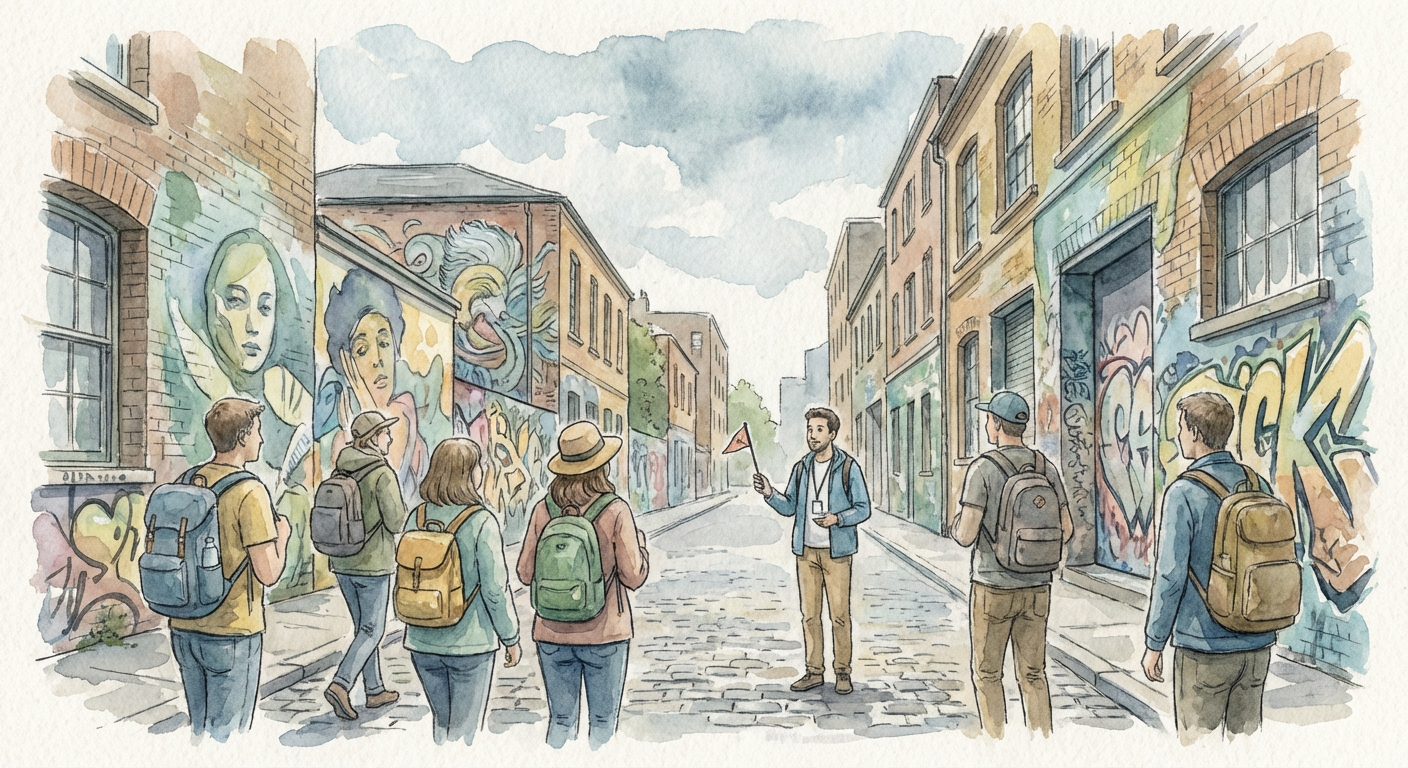
Walking tours focused on street art now rank among the top five tourist activities in major cities according to travel platforms. Guides lead groups through alleys that were once ignored or avoided. Former sites of creative rebellion become mandatory photo opportunities for visitors seeking authentic urban experiences.

This popularity creates some genuinely weird tensions. Tourists want transgression but demand safety. They want authenticity but prefer curated experiences. Tour operators have to balance genuine street culture with commercial viability. What you get is sanitized rebellion, transgression with training wheels.

Local artists face impossible choices. Participate in the tours and gain exposure but risk losing street cred. Avoid commercialization but miss economic opportunities. Some embrace the platform, others retreat deeper underground. The movement splits along commercial lines that didn’t exist when spray cans were the only currency.

Tourism’s influence goes way beyond individual artists to entire neighborhoods. Areas known for street art get hit with gentrification pressures. The art that originally reflected community identity becomes the catalyst for community displacement. Success plants the seeds of its own destruction.

Government Gatekeepers and Creative Negotiations

Municipal authorities are stuck with impossible equations. Invest millions in public art while simultaneously funding graffiti removal. Celebrate approved murals while prosecuting unauthorized ones. The line between vandalism and valuable culture often depends entirely on permission and context.

Some cities have developed more sophisticated approaches. Legal walls provide designated spaces for experimentation. Permit systems allow temporary installations. Community input processes make sure local voices influence what appears in their neighborhoods. These frameworks try to harness creative energy while maintaining civic order.

But something essential gets lost in translation. Bureaucratic approval processes completely contradict street art’s spontaneous, unauthorized nature. When rebellion requires permits, is it still rebellion? When transgression becomes policy, what replaces the original creative impulse?

The most successful programs actually acknowledge this tension instead of pretending it doesn’t exist. They create space for both sanctioned and unsanctioned work. They recognize that cities need controlled creativity and uncontrolled expression. Balance becomes the goal, not elimination.

Digital Frontiers and Collective Spaces

Technology pushes street art beyond static walls into dynamic, interactive territories. Digital projection mapping transforms buildings into moving canvases. Augmented reality layers virtual artworks over physical spaces. Artists working with Widewalls street art coverage increasingly experiment with these hybrid approaches.

Artist collectives simultaneously move in the opposite direction, reclaiming abandoned buildings as temporary gallery spaces. These groups create alternative circuits that parallel but don’t replace traditional institutions. They prove that artistic community can exist outside established systems while still reaching broader audiences.

The comparison between high-tech innovation and low-fi occupation shows different strategies for expanding artistic territory. Both approaches want to democratize art access. Both challenge institutional control over cultural production. But their methods and audiences often stay completely separate.

According to Street Art News, these parallel developments suggest street art continues evolving rather than getting replaced. Digital tools expand possibilities without killing the basic urge toward direct, immediate, physical mark-making.

Street art’s journey from underground rebellion to mainstream cultural force shows how creative movements adapt, split apart, and regenerate across changing contexts. Each transformation creates new tensions and possibilities, keeping the conversation between authority and artistic freedom perpetually unresolved. And maybe that’s exactly how it should be.

From Underground to Mainstream: How Street Art is Rewriting Urban Culture

The Anonymous Economy

A masked figure emerges from the shadows of capitalism. Works appear overnight on walls across continents. The market responds with fervor rarely seen in traditional art circles. Anonymous street artist Banksy has built an empire worth over one hundred million dollars annually without ever revealing their identity.

From Underground to Mainstream: How Street Art is Rewriting Urban Culture

This paradox defines where we are right now. Street art, once the domain of rebellious youth armed with spray cans, now commands gallery prices and corporate attention. The underground has surfaced, bringing its raw energy into boardrooms and auction houses. Museums are scrambling to acquire pieces originally created as acts of defiance against institutional power.

The transformation goes way beyond individual success stories. What started as territorial marking and political protest has become a legitimate art movement that shapes how cities look worldwide. Widewalls street art coverage documents this shift from vandalism to valued cultural expression. And honestly, it’s fascinating to watch.

Illustration for From Underground to Mainstream: How Street Art is Rewriting Urban Culture

Reclaiming the Urban Canvas

City planners walk different streets today. Where advertising billboards once dominated sightlines, commissioned murals now tell neighborhood stories. Urban renewal projects increasingly replace commercial hoardings with community-driven art that reflects local identity rather than corporate messaging.

This shift is more than aesthetic preference. Municipal governments have figured out that street art can transform neglected areas into cultural destinations. Property values rise. Tourism follows. What once required expensive marketing campaigns now happens organically through authentic artistic expression.

The process requires careful balance. Cities have to preserve spontaneous creativity while managing planned development. Some walls stay open as canvases for emerging artists. Others feature established names working on large-scale commissions that anchor neighborhoods in artistic identity. It’s a delicate dance between control and chaos.

The Tourist Trail Revolution

Guidebooks rewrite themselves annually. Street art tours now rank among the top five activities in major cities according to TripAdvisor data. Visitors want authentic cultural experiences beyond traditional museums and monuments. They want to discover hidden murals in industrial districts and watch artists at work.

This demand creates new economic opportunities. Local guides specialize in underground art scenes. Artists adapt their practice to include interaction with curious tourists. Neighborhoods previously considered sketchy become essential stops on cultural itineraries.

The phenomenon has gone global. Berlin’s East Side Gallery draws millions to remaining sections of the Berlin Wall. London’s Shoreditch attracts weekend crowds hunting for Instagram-worthy backdrops. Mexico City’s Roma Norte neighborhood transforms through artistic intervention and the foot traffic that follows. Each city develops its own street art personality.

The Municipal Balancing Act

City hall meetings have gotten complicated. Officials navigate between property owners demanding graffiti removal and arts advocates pushing for public art investment. The line between vandalism and valuable cultural expression blurs daily. Legal frameworks struggle to keep up with artistic innovation.

Some cities take pragmatic approaches. They designate legal walls where artists can work without fear of prosecution. Others create permit systems for larger murals while cracking down hard on unauthorized tagging. The smartest municipalities hire former graffiti artists as community liaisons and cultural consultants.

Budget allocations reflect this evolution. Money previously spent entirely on cleaning and covering unauthorized artwork now supports commissioned pieces and artist residencies. The economic argument makes sense: investing in legitimate street art prevents illegal graffiti while generating cultural capital that attracts businesses and residents.

Digital Dimensions and Collective Spaces

Technology is expanding what’s possible beyond physical walls. Digital projection mapping transforms static murals into interactive experiences that respond to movement and sound. Artists collaborate with programmers to create augmented reality layers that viewers access through smartphone apps. The boundary between physical and virtual art is dissolving before our eyes.

Meanwhile, artist collectives are reclaiming forgotten urban spaces as temporary galleries. Abandoned warehouses become exhibition venues for emerging talent. Empty lots transform into outdoor installations that exist until development pressure forces relocation. Street Art News chronicles these temporary projects that capture contemporary artistic energy.

These collective efforts show how art can activate underutilized spaces. Property owners discover that artistic occupation prevents vandalism and draws positive attention to their holdings. Developers begin factoring street art into renovation plans, recognizing the cultural value these artists bring to neighborhoods.

The movement keeps changing as artists push boundaries between sanctioned and subversive expression. Each generation redefines what authentic street art looks like versus commercialized knockoffs. The conversation itself becomes part of the artistic process, keeping public art dynamic and culturally relevant.

Walk any major city today and you’ll witness this transformation firsthand. Notice which walls speak with authorized voices and which whisper underground messages. Watch how communities interact with artwork in their daily routines. The streets themselves tell the story of art’s power to reshape urban experience one wall at a time.

From Spray Cans to Smart Cities: The Craft Evolution of Public Art

The Anonymous Million-Dollar Movement

A masked figure works in darkness. Stencils cut by hand. Spray paint applied with surgical precision. The artist vanishes before dawn, leaving behind work that will generate over one hundred million dollars in annual market value. This is the paradox of contemporary street art. Unknown creators command astronomical prices while their identities remain shadows.

From Spray Cans to Smart Cities: The Craft Evolution of Public Art

We’re way beyond rebellious tags on subway cars now. Today’s street artists use techniques that would make Renaissance masters take notice. Layer upon layer of paint builds genuine depth. Stencils need mathematical precision. Wheat paste applications depend on perfect timing with weather conditions. Every element works toward the final vision.

This technical skill explains why anonymous works sell for millions at auction. Collectors know they’re buying countless hours of perfected spray control. They see the innovation in materials. The risk calculation. Pure craft distilled into moments of creation that turn concrete into canvas.

Illustration for From Spray Cans to Smart Cities: The Craft Evolution of Public Art

The Industrial Canvas Revolution

Construction hoardings used to show ads for luxury watches and fast fashion. Now they hold thirty-foot murals created through methodical grid systems and custom paint formulations. Urban planners figured out that commissioning artists costs less than traditional advertising while delivering more community impact.

The process starts months before the first brushstroke. Artists study building facades. They calculate sun exposure and wind patterns. Paint formulations have to survive weather extremes. Some murals need scaffolding systems engineered specifically for the project. Others require specialized lifts and safety equipment that costs thousands per day.

Municipal contracts now specify everything from primer types to final protective coatings. Artists submit detailed material lists and timeline breakdowns. The bureaucracy might seem to clash with street art’s origins, but it has elevated the craft. Resources that guerrilla artists never had access to now fuel ambitious public works that blur the line between vandalism and civic beautification.

Digital Meets Analog in Urban Spaces

Projection mapping turns static murals into living installations. Artists code alongside painting. They design animations that respond to pedestrian movement. Temperature sensors trigger color changes. Sound levels alter visual patterns. The craft has grown beyond traditional pigments into programming and sensor integration.

Creating these hybrid works means mastering multiple disciplines. Traditional painting techniques provide the foundation. Digital art skills enable the interactive layers. Engineering knowledge helps installations survive urban environments. Artists spend months calibrating projector angles and testing weather resistance. Each element has to sync perfectly.

The tools tell the story. Laptops sit beside spray cans. Custom software renders alongside hand-mixed paints. Motion sensors get mounted with the same precision once reserved for stencil placement. This technological integration hasn’t replaced traditional techniques. Instead, it amplifies them. The basic craft remains unchanged while the possibilities multiply.

Travel platforms now rank street art tours among the top five urban activities worldwide. Visitors want authentic encounters with creative processes. They want to understand the making, not just admire the results. This demand has changed how artists approach their practice and how cities manage their creative resources. Widewalls street art coverage documents this global phenomenon as it unfolds across continents.

Reclaiming Space Through Temporary Creation

Abandoned warehouses become galleries for three months. Artist collectives install temporary exhibitions in vacant lots. The space transforms through collective labor. Walls get fresh primer. Lighting systems appear overnight. Floors get swept and sealed. These pop-up galleries need the same attention to craft as permanent installations.

The preparation process shows how committed artists are to quality over longevity. Knowing their work will disappear doesn’t reduce the effort invested. If anything, the temporary nature intensifies focus on execution. Every brushstroke matters more when time is limited. Materials have to perform flawlessly under compressed schedules.

Documentation becomes crucial in temporary spaces. Artists photograph each stage of creation. Time-lapse cameras capture entire murals emerging from blank walls. The process footage often outlives the physical artwork. This shift toward documenting creation has influenced how permanent pieces develop. Artists now consider the making as important as the final result.

City governments make daily decisions about which unauthorized artworks to remove and which to preserve. Graffiti removal budgets compete with public art investments. The distinction often comes down to craft quality and community reception. Quick tags disappear within days. Complex murals that show real technical skill might earn protection status. Street Art News tracks these policy developments as they reshape urban creative landscapes.

Tools, Techniques, and Tomorrow

The spray can is still fundamental, but artists now modify nozzles for specific effects. Custom caps create unique spray patterns. Pressure regulators ensure consistent flow. Paint formulations resist UV damage and weather wear. Some artists mix their own colors using industrial pigments. Others work with manufacturers to develop entirely new paint technologies.

Stencil cutting has turned into precision engineering. Laser cutters create complex designs impossible to achieve by hand. Computer modeling predicts how multi-layer stencils will interact. Registration marks ensure perfect alignment across massive walls. The digital design process can take weeks before physical creation begins.

Beyond traditional tools, artists now use 3D printers for creating textural elements. Vinyl plotters cut precise adhesive designs. Heat guns and specialized solvents enable temporary installations that leave no permanent trace. The expansion of available tools hasn’t simplified the craft. Instead, it has revealed new layers of complexity and possibility.

The future promises even greater integration between digital innovation and traditional techniques. Virtual reality allows artists to preview large-scale works before committing paint to wall. Augmented reality layers add interactive elements visible through mobile devices. These technological advances complement rather than replace basic artistic skills. The craft keeps evolving while honoring its roots in direct, immediate creation that transforms public space through human expression and technical mastery.

The New Economics of Making Art: How Independent Creators Are Rewriting the Rules

The Streaming Economy vs. The Patronage Renaissance

The numbers tell a stark story. Musicians relying on streaming platforms earn less than $500 annually on average, with the bottom 90 percent barely registering as blips in algorithmic revenue streams. This digital sharecropping system promises exposure but delivers poverty wages. Yet something fascinating emerges when we examine the parallel rise of direct-support platforms.

Bandcamp and Patreon represent a fundamental shift back toward patronage models that sustained artists for centuries. These platforms bypass the middleman mathematics of streaming, creating direct economic relationships between creators and supporters. The comparison reveals a tension between scale and sustainability. Streaming offers theoretical access to millions but pays in fractions. Direct support reaches fewer people but pays in dollars.

This divergence forces artists to choose between two entirely different economic philosophies. Do you chase the lottery ticket of viral reach, or do you build a garden of dedicated supporters? The most successful independent artists increasingly choose both, treating streaming as discovery and direct platforms as business.

Urban Exodus and Alternative Spaces

Studio rents in major cities have pushed working artists beyond the urban core, fundamentally altering where and how art gets made. A painter who once walked to galleries in Chelsea now commutes from Queens. A sculptor leaves Brooklyn for Detroit. This geographic dispersion challenges the traditional art world’s dependence on proximity and presence.

Artist residency programs have expanded to fill this gap, offering temporary access to resources and community that permanent urban studios once provided. These programs create artificial art ecosystems, complete with critique, collaboration, and exhibition opportunities. The comparison between residencies and traditional studio culture reveals how economic pressure has actually diversified artistic experience.

Rural residencies offer space and time that urban studios never could. Mountain retreats provide different inspiration than warehouse districts. The forced migration of artists has accidentally democratized access to varied creative environments. What began as economic necessity has become artistic opportunity.

Blockchain’s Reality Check

The NFT bubble burst spectacularly, leaving behind digital debris and bitter investors. Yet this collapse cleared space for more practical applications of blockchain technology in art. Provenance tracking, authenticity verification, and transparent ownership records survived the speculative frenzy. The comparison between NFT hype and blockchain utility illustrates how technology adoption follows predictable cycles.

Artists who embraced NFTs for quick profits found themselves holding worthless tokens. Those who understood blockchain as infrastructure built sustainable systems for documenting and selling their work. The technology’s real value lies not in artificial scarcity but in genuine transparency. Artsy contemporary art platforms increasingly integrate these verification tools without the speculative theater.

This technological maturation mirrors other artistic tool adoptions. Photography was once dismissed as mechanical reproduction. Digital art faced similar skepticism. Now blockchain joins the toolkit of serious artists who understand its practical applications while ignoring its promotional noise.

AI and the Authorship Question

Machine-generated images have exploded into public consciousness, triggering debates about creativity, originality, and artistic labor that echo historical technological disruptions. The comparison to photography’s 19th-century reception proves instructive. Critics once argued cameras merely recorded reality rather than creating art. Today’s AI critics make similar arguments about algorithmic generation.

The economic implications extend beyond philosophical debate. If machines can produce images instantly, what happens to illustrators, graphic designers, and commercial artists? The parallel to automation in other industries suggests adaptation rather than elimination. Artists who embrace AI as a tool maintain competitive advantage over those who resist or ignore it.

Independent artists face particular pressure here. Larger studios can afford teams of specialists. Solo creators must master multiple roles. AI levels this playing field, allowing individual artists to compete with larger operations. The technology that threatens to replace human creativity might actually democratize artistic production. Hyperallergic art criticism continues to grapple with these evolving definitions of artistic practice.

The Portfolio Career Reality

Modern independent artists rarely rely on single revenue streams. They teach workshops, sell originals, license designs, offer commissions, and maintain subscription services simultaneously. This portfolio approach requires entrepreneurial skills that art schools traditionally ignored. The comparison between fine art purity and commercial necessity reveals how economic reality has redefined artistic practice.

Social media amplifies this diversification. Instagram becomes both gallery and storefront. TikTok works as marketing channel and performance space. Artists must simultaneously create, curate, market, and sell their work. This multiplication of roles would have overwhelmed previous generations, but digital natives navigate it naturally.

The most successful independent artists treat their practice as integrated creative businesses rather than pure artistic expression. They understand that sustainable creativity requires sustainable economics. This pragmatic approach doesn’t diminish artistic integrity, it ensures artistic longevity.

These economic transformations aren’t temporary disruptions but permanent shifts in how art gets made, distributed, and valued. Independent artists who understand these new rules gain significant advantages over those clinging to outdated models. Success belongs to creators who can navigate both artistic vision and economic reality with equal sophistication.

From Bedroom to Billboard: How Home Studios Redefined Music Production

The Democratization of Sound

The revolution happened quietly, one bedroom at a time. While major labels invested millions in pristine acoustics and vintage gear, a generation of artists armed themselves with laptops and $100 microphones. Today, nearly three-quarters of all music uploaded to Spotify comes from home recording setups. This isn’t just a trend. It’s a fundamental shift in how music gets made.

Digital Audio Workstations like Ableton Live, FL Studio, and Logic Pro have torn down traditional barriers to entry. What once required expensive studio time and engineering expertise now fits on a MacBook. The learning curve is still steep, but the financial moat has vanished. An ambitious teenager in Toledo has the same production tools as chart-topping artists.

This accessibility sparked something unexpected. Instead of flooding the market with amateur recordings, it created a sophisticated aesthetic built around imperfection. Bedroom pop emerged as the genre that celebrated the sonic fingerprints of home recording: slight room reverb, gentle compression artifacts, and the warm saturation of overdriven preamps.

The Bedroom Pop Blueprint

Bedroom pop didn’t stumble into commercial success. Artists like Clairo, Rex Orange County, and Boy Pablo crafted a sound that transformed technical limitations into artistic statements. Since 2019, the genre has consistently produced Billboard-charting artists who began recording in actual bedrooms.

The production technique centers on controlled lo-fi aesthetics. Producers deliberately introduce tape saturation, vinyl crackle, and subtle pitch wobble. They layer vintage synthesizer patches over drum machines programmed with swing that mimics human timing inconsistencies. The result sounds effortless but requires careful attention to detail.

Modern bedroom pop producers study the grain structure of different microphone preamps like wine enthusiasts examine terroir. They know which plugins emulate the specific character of a 1960s Ampex tape machine versus a 1970s Studer. Sound on Sound production techniques become essential reading for artists chasing that perfect intersection of nostalgic warmth and contemporary clarity.

The Sample Dilemma

Home production’s democratization hit a wall when artists started sampling. The same technology that lowered production barriers couldn’t solve sample clearance costs, which often exceed tens of thousands of dollars for recognizable material. Independent artists found themselves priced out of hip-hop’s foundational technique.

This created a creative fork in the road. Some artists pivoted toward original composition, developing sophisticated interpolation techniques that capture the essence of classic tracks without triggering clearance requirements. Others embraced AI-powered stem separation tools that can isolate individual instruments from complete recordings.

These AI tools operate in legal gray areas. They enable unauthorized remixing at unprecedented scale, allowing producers to extract vocal lines, drum patterns, or bass parts from copyrighted material. The technology works with surgical precision, but its use raises questions about artistic integrity and intellectual property that the music industry continues to wrestle with.

The Vinyl Renaissance Meets Digital Production

Physical media staged an unlikely comeback alongside the bedroom recording boom. For the third consecutive year, vinyl sales have outperformed CD sales, driven partly by bedroom pop artists who treat album artwork and packaging as extensions of their aesthetic vision.

This creates fascinating production paradoxes. Artists record digitally but master specifically for vinyl playback, adjusting frequency response and dynamic range to optimize the analog listening experience. They study the technical specifications of different pressing plants, understanding how various vinyl compounds affect frequency reproduction.

The resurgence reflects deeper cultural shifts around music consumption. Streaming offers infinite access but minimal tactile engagement. Vinyl provides physical connection to the music-making process. Bedroom pop artists exploit this tension, creating digital music that explicitly references analog warmth while offering beautifully designed physical artifacts for collectors.

Modern producers often maintain parallel mastering chains: streaming-optimized versions with competitive loudness levels, and vinyl masters with extended dynamic range that breathe properly when pressed to wax. Pitchfork music criticism frequently highlights how artists navigate these technical considerations while maintaining artistic coherence.

Where This All Leads

The bedroom pop phenomenon revealed something important about creativity under constraints. When expensive studios became optional, artists discovered that limitations often fuel innovation more effectively than unlimited resources. The best home recordings don’t sound amateur. They sound intentional.

Contemporary producers are pushing these techniques into unexpected territories. They’re applying bedroom pop’s texture-focused approach to electronic music, jazz, and even metal. The methodology transcends genre: identify your technical constraints, then transform them into aesthetic advantages.

This represents more than technological progress. It’s a philosophical shift toward valuing artistic vision over production polish. The most compelling music emerges when creators embrace their circumstances rather than apologizing for them. Whether that means celebrating the ambient noise of a bedroom recording or the characteristic distortion of an overdriven audio interface, authenticity beats perfection.

The tools continue evolving, but the core insight remains constant: great music comes from great ideas, not great gear. What production techniques are you experimenting with in your own creative space?

What Introduction and gateway writing Reveals About Independent art and the economics of making work

The standard take is missing the more important signal underneath. The topic of independent art and the economics of making work rewards more careful attention than the typical coverage provides, and the reason is not complicated once you know where to look.

What makes this genuinely different from previous cycles is that Bandcamp and Patreon let artists sell directly to fans. This bypasses the old gatekeepers entirely. The optimistic reading of the situation also happens to be the more accurate one once you examine what the evidence actually shows.

The Writing: Setting the Terms

Here’s the number that explains everything: artist income from streaming platforms averages under $500 per year for the bottom 90 percent. This isn’t just a sad statistic, it’s the structural condition that makes everything else in this analysis make sense. These conditions have been building for years, and the convergence is what makes right now different from previous moments that looked similar from a distance.

Bandcamp and Patreon create direct artist-to-fan economics.

The cost of studio space in major cities is pricing artists out of urban centres. Artsy contemporary art has been tracking this consistently.

What makes this moment worth examining carefully is not the novelty but the confirmation. The underlying dynamics have been visible for some time. What’s new is that they’ve reached a threshold where ignoring them requires active effort rather than simple inattention. That threshold crossing is the event, not the underlying movement that produced it.

And artist residency programmes are growing as an alternative to the commercial gallery system. These elements don’t exist separately, they’re reinforcing conditions in the same structural shift.

The Accessibility Guide: The Analysis

Here’s where the analysis gets more specific. The surface reading is accessible and not wrong, but it misses the mechanism. The mechanism is this: NFT speculation collapsed but on-chain provenance tools remain useful. Understanding this changes what you do with the information.

AI image generation is creating new conversations about originality and authorship.

The skeptical counterargument deserves honest engagement: prior moments with similar surface characteristics didn’t produce the outcomes that seemed logical at the time. That history is real. What’s different now is AI image generation creating new conversations about originality and authorship, which isn’t a minor variable. It’s the infrastructure condition that previous cycles lacked. Infrastructure changes tend to stick around in ways that sentiment-driven changes don’t. Hyperallergic art criticism is one source tracking this with the rigour it requires.

There’s also a distributional question that often goes unaddressed: who captures the value created by these shifts, and who absorbs the disruption costs? The aggregate picture can be positive while the distribution is uneven in ways that matter enormously to specific participants. Keeping that distributional lens in view is part of reading the situation clearly rather than simply optimistically.

Implications: What This Means If You Care About Starting points for difficult genres

The implications extend beyond the immediate context. Artist income from streaming platforms averaging under $500 per year for the bottom 90 percent, combined with the structural conditions described above, creates a situation where adjacent fields, decisions, and communities are affected in ways that aren’t always visible. The second-order effects are frequently more important than the first-order ones.

Culturally literate, opinionated, allergic to safe takes.

The practical question isn’t whether to engage with these dynamics but how. The answer depends on context, on what role you occupy and what your actual decision horizon is. But the first step is the same regardless: accurate understanding of what’s actually happening rather than what the most available narrative says is happening.

A few concrete observations worth separating out. First: Bandcamp and Patreon creating direct artist-to-fan economics isn’t a temporary condition, it’s a new baseline. Second: NFT speculation collapsed but on-chain provenance tools remaining useful suggests the adjustment period isn’t over. Third, and most important: the organisations and individuals who are treating the current moment as a new steady state rather than a transition are making a categorisation error that will be costly to unwind later.

The Case Against: What the Critics Get Right

Intellectual honesty requires acknowledging the strongest counterarguments, not just the weakest ones. The case against the optimistic reading isn’t trivial. There are structural vulnerabilities in the current picture that deserve direct engagement rather than dismissal.

The most serious objection is about sustainability. The cost of studio space in major cities pricing artists out of urban centres can be read not as a foundation but as a ceiling, a point beyond which growth becomes self-limiting because of the very dynamics that produced it. If the current state has already incorporated most early-adopting participants, the remaining growth curve may be structurally shallower than the recent trajectory implies.

AI image generation is creating new conversations about originality and authorship.

Looking Forward

The trajectory here is clearer than the pace. Making predictions about when specific thresholds will be crossed is genuinely difficult, and anyone claiming precision about timelines should be treated with scepticism. But the direction, toward continued development of the conditions described above, is supported by the evidence in a way that doesn’t depend on a single variable going right.

AI image generation creating new conversations about originality and authorship is the variable to watch as the leading indicator. Historical patterns suggest it moves first, with broader metrics following with some lag. This doesn’t make the outcome certain, but it makes it legible. And legibility is what you need for good decisions.

Three questions are worth holding as the story develops. First: are the structural conditions that enabled the current state durable, or are they cyclical? Second: who’s positioned to benefit from the next phase, and does that differ materially from who benefited in the current phase? Third: what would a clean falsification of the optimistic thesis look like, and is there any evidence of that signal emerging? These questions don’t need answers today, but having asked them changes what you notice in the months ahead.

The direction here is clear even when the pace isn’t.

What’s the thing you wish someone had told you at the start?

The Real Picture on Music production and bedroom pop culture

The standard take is missing the more important signal underneath. Music production and bedroom pop culture deserves more careful attention than the typical coverage provides, and the reason isn’t complicated once you know where to look.

What makes this genuinely different from previous cycles is simple: DAWs like Ableton, FL Studio, and Logic have dropped production barriers to zero. Once you examine what the evidence actually shows, this reading becomes both more fascinating and more accurate.

The Craft: Setting the Terms

Here’s the key stat: 70 percent of music submitted to Spotify in 2025 was created with home recording setups. This isn’t just a data point—it’s the structural condition that makes everything else in this analysis make sense. These conditions have been building for years. The convergence is what makes right now distinct from previous moments that looked similar from a distance.

DAWs like Ableton, FL Studio, and Logic have dropped production barriers to zero.

The bedroom pop genre has generated consistent Billboard charting artists since 2019. Pitchfork music criticism has been tracking this consistently.

What makes this moment worth examining carefully isn’t the novelty but the confirmation. The underlying dynamics have been visible for some time. What’s new is that they’ve reached a threshold where ignoring them requires active effort rather than simple inattention. That threshold crossing is the event, not the underlying movement that produced it.

Sample clearance costs are blocking independent artists from using classic material, and that’s part of the same picture. These elements don’t exist in separate silos—they’re reinforcing conditions in the same structural shift.

The Process Piece: The Analysis

Sample clearance costs blocking independent artists from using classic material is where the analysis gets more specific. The surface reading is accessible and not wrong, but it misses the mechanism. The mechanism is where the practical insight lives. What makes this genuinely different from previous cycles is AI stem separation tools enabling unauthorized remixing at scale. Understanding this changes what you do with the information.

Vinyl sales outperformed CD sales for the third consecutive year in 2025.

The skeptical counterargument deserves honest engagement: prior moments with similar surface characteristics didn’t produce the outcomes that seemed logical at the time. That history is real. What’s different now is vinyl sales outperforming CD sales for the third consecutive year in 2025, which isn’t a minor variable. It’s the infrastructure condition that previous cycles lacked. Infrastructure changes tend to be persistent in ways that sentiment-driven changes are not. Sound on Sound production is one source tracking this with the rigor it requires.

There’s also a distributional question that often goes unaddressed in coverage of music production and bedroom pop culture: who captures the value created by these shifts, and who absorbs the disruption costs? The aggregate picture can be positive while the distribution is uneven in ways that matter enormously to specific participants. Keeping that distributional lens in view is part of reading the situation clearly rather than simply optimistically.

Implications: What This Means If You Care About Production techniques

The implications of music production and bedroom pop culture extend beyond the immediate context. 70 percent of music submitted to Spotify in 2025 created with home recording setups, combined with the structural conditions described above, creates a situation where adjacent fields, decisions, and communities are affected in ways that aren’t always visible from inside the primary story. The second-order effects are frequently more important than the first-order ones, and they’re where careful attention pays the highest returns.

Culturally literate, opinionated, allergic to safe takes.

The practical question isn’t whether to engage with these dynamics but how. The answer depends on context—on what role you occupy relative to music production and bedroom pop culture and what your actual decision horizon is. But the first step is the same regardless: accurate understanding of what’s actually happening rather than what the most available narrative says is happening.

A few concrete observations are worth separating out from the broader analysis. First: DAWs like Ableton, FL Studio, and Logic lowering production barriers to zero isn’t a temporary condition. It’s a new baseline. Second: AI stem separation tools enabling unauthorized remixing at scale suggests that the adjustment period isn’t over. Third, and most important: the organizations and individuals who are treating the current moment as a new steady state rather than a transition are making a categorization error that will be costly to unwind later.

The Case Against: What the Critics Get Right

Intellectual honesty requires acknowledging the strongest counterarguments, not just the weakest ones. The case against the optimistic reading of music production and bedroom pop culture isn’t trivial. There are structural vulnerabilities in the current picture that deserve direct engagement rather than dismissal.

The most serious objection is about sustainability. The bedroom pop genre generating consistent Billboard charting artists since 2019 can be read not as a foundation but as a ceiling—a point beyond which growth becomes self-limiting because of the very dynamics that produced it. If the current state has already incorporated most of the available supply of early-adopting participants, the remaining growth curve may be structurally shallower than the recent trajectory implies.

Vinyl sales outperformed CD sales for the third consecutive year in 2025.

Looking Forward

The trajectory here is clearer than the pace. Making predictions about when specific thresholds will be crossed is genuinely difficult, and anyone claiming precision about timelines should be treated with skepticism. But the direction—toward 70 percent of music submitted to Spotify in 2025 and continued development of the conditions described above—is supported by the evidence in a way that isn’t contingent on a single variable going right.

Vinyl sales outperforming CD sales for the third consecutive year in 2025 is the variable to watch as the leading indicator. Historical patterns suggest it moves first, with broader metrics following with some lag. This doesn’t make the outcome certain, but it makes it legible. And legibility is the precondition for good decisions.

Three questions are worth holding as the story develops. First: are the structural conditions that enabled the current state durable, or are they cyclical? Second: who is positioned to benefit from the next phase, and does that differ materially from who benefited in the current phase? Third: what would a clean falsification of the optimistic thesis look like, and is there any evidence of that signal emerging? These questions don’t need answers today, but having asked them changes what you notice in the months ahead.

The direction here is clear even when the pace isn’t.

What other process stories deserve this kind of attention?