Fritz Hut | Thoughts & Commentary

Art, culture, and the conversations that matter.

Archives (page 11 of 12)

From Spray Cans to Smart Cities: The Craft Evolution of Public Art

The Anonymous Million-Dollar Movement

A masked figure works in darkness. Stencils cut by hand. Spray paint applied with surgical precision. The artist vanishes before dawn, leaving behind work that will generate over one hundred million dollars in annual market value. This is the paradox of contemporary street art. Unknown creators command astronomical prices while their identities remain shadows.
From Spray Cans to Smart Cities: The Craft Evolution of Public Art

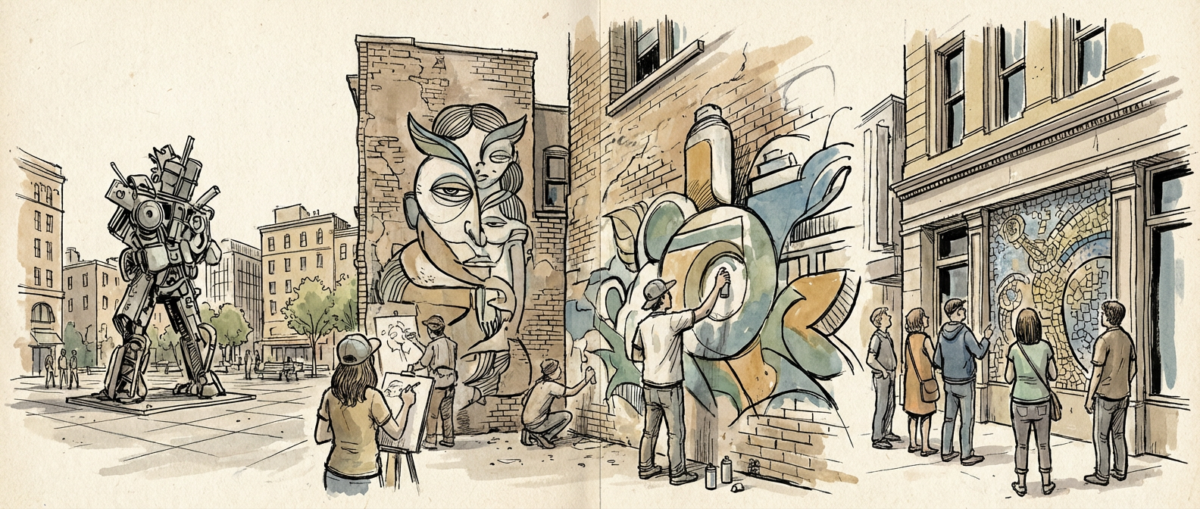
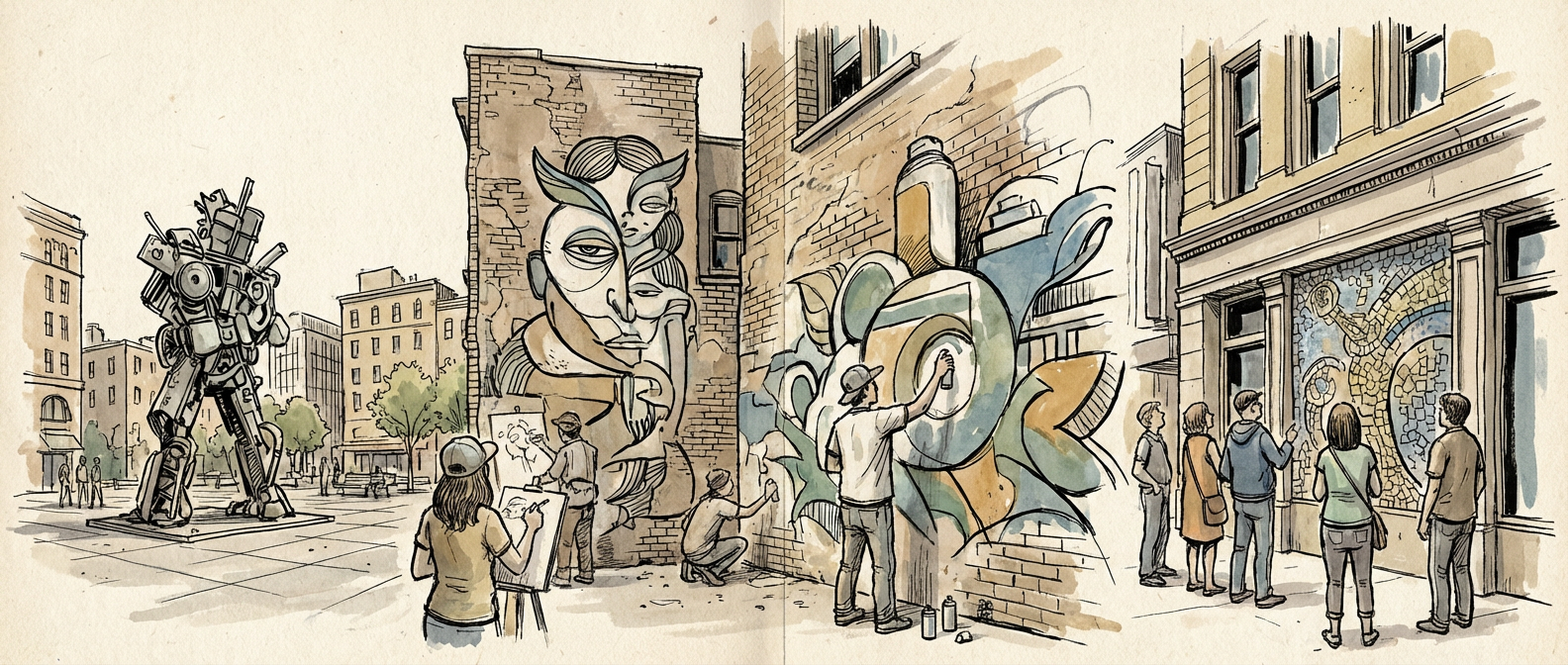
We’re way beyond rebellious tags on subway cars now. Today’s street artists use techniques that would make Renaissance masters take notice. Layer upon layer of paint builds genuine depth. Stencils need mathematical precision. Wheat paste applications depend on perfect timing with weather conditions. Every element works toward the final vision.

This technical skill explains why anonymous works sell for millions at auction. Collectors know they’re buying countless hours of perfected spray control. They see the innovation in materials. The risk calculation. Pure craft distilled into moments of creation that turn concrete into canvas.
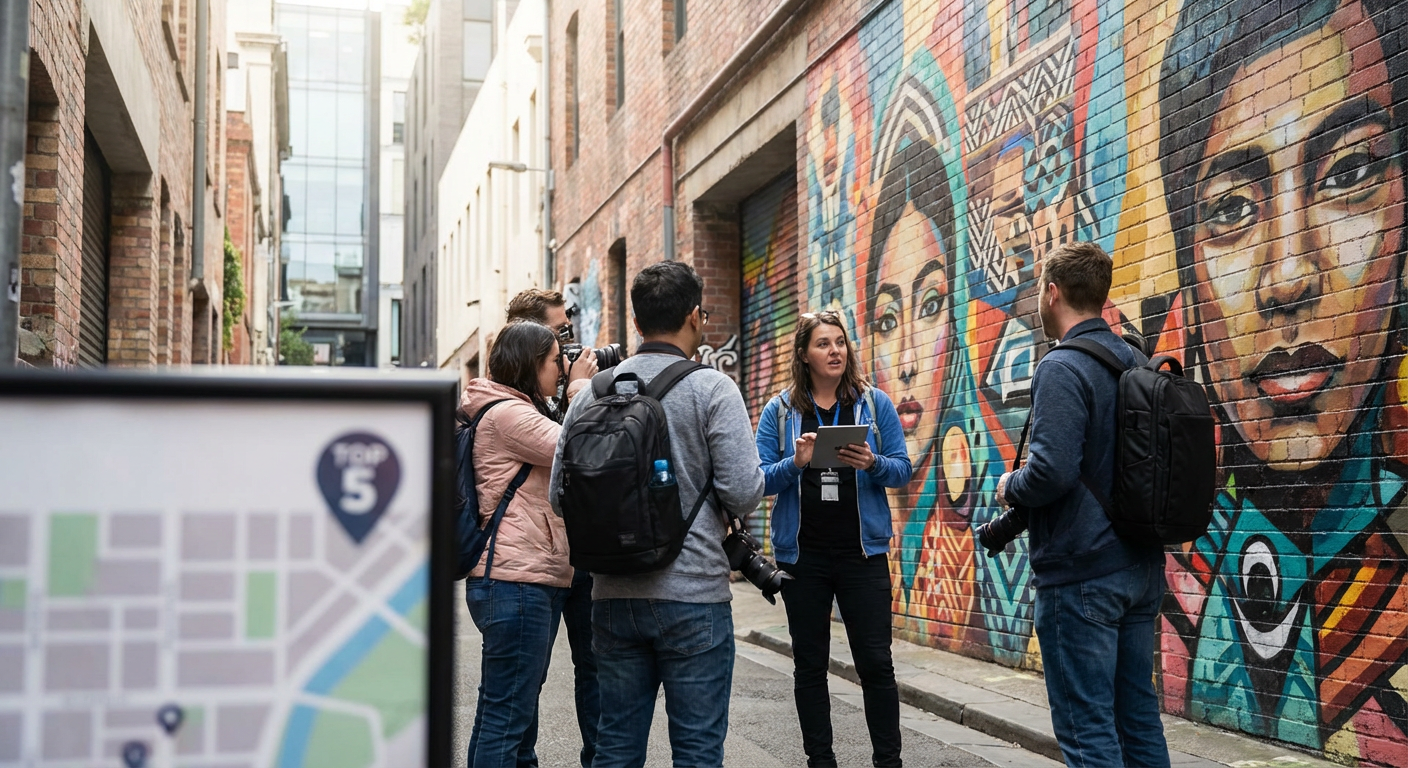
Illustration for From Spray Cans to Smart Cities: The Craft Evolution of Public Art

The Industrial Canvas Revolution

Construction hoardings used to show ads for luxury watches and fast fashion. Now they hold thirty-foot murals created through methodical grid systems and custom paint formulations. Urban planners figured out that commissioning artists costs less than traditional advertising while delivering more community impact.

The process starts months before the first brushstroke. Artists study building facades. They calculate sun exposure and wind patterns. Paint formulations have to survive weather extremes. Some murals need scaffolding systems engineered specifically for the project. Others require specialized lifts and safety equipment that costs thousands per day.

Municipal contracts now specify everything from primer types to final protective coatings. Artists submit detailed material lists and timeline breakdowns. The bureaucracy might seem to clash with street art’s origins, but it has elevated the craft. Resources that guerrilla artists never had access to now fuel ambitious public works that blur the line between vandalism and civic beautification.

Digital Meets Analog in Urban Spaces

Projection mapping turns static murals into living installations. Artists code alongside painting. They design animations that respond to pedestrian movement. Temperature sensors trigger color changes. Sound levels alter visual patterns. The craft has grown beyond traditional pigments into programming and sensor integration.

Creating these hybrid works means mastering multiple disciplines. Traditional painting techniques provide the foundation. Digital art skills enable the interactive layers. Engineering knowledge helps installations survive urban environments. Artists spend months calibrating projector angles and testing weather resistance. Each element has to sync perfectly.

The tools tell the story. Laptops sit beside spray cans. Custom software renders alongside hand-mixed paints. Motion sensors get mounted with the same precision once reserved for stencil placement. This technological integration hasn’t replaced traditional techniques. Instead, it amplifies them. The basic craft remains unchanged while the possibilities multiply.

Travel platforms now rank street art tours among the top five urban activities worldwide. Visitors want authentic encounters with creative processes. They want to understand the making, not just admire the results. This demand has changed how artists approach their practice and how cities manage their creative resources. Widewalls street art coverage documents this global phenomenon as it unfolds across continents.

Reclaiming Space Through Temporary Creation

Abandoned warehouses become galleries for three months. Artist collectives install temporary exhibitions in vacant lots. The space transforms through collective labor. Walls get fresh primer. Lighting systems appear overnight. Floors get swept and sealed. These pop-up galleries need the same attention to craft as permanent installations.

The preparation process shows how committed artists are to quality over longevity. Knowing their work will disappear doesn’t reduce the effort invested. If anything, the temporary nature intensifies focus on execution. Every brushstroke matters more when time is limited. Materials have to perform flawlessly under compressed schedules.

Documentation becomes crucial in temporary spaces. Artists photograph each stage of creation. Time-lapse cameras capture entire murals emerging from blank walls. The process footage often outlives the physical artwork. This shift toward documenting creation has influenced how permanent pieces develop. Artists now consider the making as important as the final result.

City governments make daily decisions about which unauthorized artworks to remove and which to preserve. Graffiti removal budgets compete with public art investments. The distinction often comes down to craft quality and community reception. Quick tags disappear within days. Complex murals that show real technical skill might earn protection status. Street Art News tracks these policy developments as they reshape urban creative landscapes.

Tools, Techniques, and Tomorrow

The spray can is still fundamental, but artists now modify nozzles for specific effects. Custom caps create unique spray patterns. Pressure regulators ensure consistent flow. Paint formulations resist UV damage and weather wear. Some artists mix their own colors using industrial pigments. Others work with manufacturers to develop entirely new paint technologies.

Stencil cutting has turned into precision engineering. Laser cutters create complex designs impossible to achieve by hand. Computer modeling predicts how multi-layer stencils will interact. Registration marks ensure perfect alignment across massive walls. The digital design process can take weeks before physical creation begins.

Beyond traditional tools, artists now use 3D printers for creating textural elements. Vinyl plotters cut precise adhesive designs. Heat guns and specialized solvents enable temporary installations that leave no permanent trace. The expansion of available tools hasn’t simplified the craft. Instead, it has revealed new layers of complexity and possibility.

The future promises even greater integration between digital innovation and traditional techniques. Virtual reality allows artists to preview large-scale works before committing paint to wall. Augmented reality layers add interactive elements visible through mobile devices. These technological advances complement rather than replace basic artistic skills. The craft keeps evolving while honoring its roots in direct, immediate creation that transforms public space through human expression and technical mastery.


The New Economics of Making Art: How Independent Creators Are Rewriting the Rules

The Streaming Economy vs. The Patronage Renaissance

The numbers tell a stark story. Musicians relying on streaming platforms earn less than $500 annually on average, with the bottom 90 percent barely registering as blips in algorithmic revenue streams. This digital sharecropping system promises exposure but delivers poverty wages. Yet something fascinating emerges when we examine the parallel rise of direct-support platforms.

Bandcamp and Patreon represent a fundamental shift back toward patronage models that sustained artists for centuries. These platforms bypass the middleman mathematics of streaming, creating direct economic relationships between creators and supporters. The comparison reveals a tension between scale and sustainability. Streaming offers theoretical access to millions but pays in fractions. Direct support reaches fewer people but pays in dollars.

This divergence forces artists to choose between two entirely different economic philosophies. Do you chase the lottery ticket of viral reach, or do you build a garden of dedicated supporters? The most successful independent artists increasingly choose both, treating streaming as discovery and direct platforms as business.

Urban Exodus and Alternative Spaces

Studio rents in major cities have pushed working artists beyond the urban core, fundamentally altering where and how art gets made. A painter who once walked to galleries in Chelsea now commutes from Queens. A sculptor leaves Brooklyn for Detroit. This geographic dispersion challenges the traditional art world’s dependence on proximity and presence.

Artist residency programs have expanded to fill this gap, offering temporary access to resources and community that permanent urban studios once provided. These programs create artificial art ecosystems, complete with critique, collaboration, and exhibition opportunities. The comparison between residencies and traditional studio culture reveals how economic pressure has actually diversified artistic experience.

Rural residencies offer space and time that urban studios never could. Mountain retreats provide different inspiration than warehouse districts. The forced migration of artists has accidentally democratized access to varied creative environments. What began as economic necessity has become artistic opportunity.

Blockchain’s Reality Check

The NFT bubble burst spectacularly, leaving behind digital debris and bitter investors. Yet this collapse cleared space for more practical applications of blockchain technology in art. Provenance tracking, authenticity verification, and transparent ownership records survived the speculative frenzy. The comparison between NFT hype and blockchain utility illustrates how technology adoption follows predictable cycles.

Artists who embraced NFTs for quick profits found themselves holding worthless tokens. Those who understood blockchain as infrastructure built sustainable systems for documenting and selling their work. The technology’s real value lies not in artificial scarcity but in genuine transparency. Artsy contemporary art platforms increasingly integrate these verification tools without the speculative theater.

This technological maturation mirrors other artistic tool adoptions. Photography was once dismissed as mechanical reproduction. Digital art faced similar skepticism. Now blockchain joins the toolkit of serious artists who understand its practical applications while ignoring its promotional noise.

AI and the Authorship Question

Machine-generated images have exploded into public consciousness, triggering debates about creativity, originality, and artistic labor that echo historical technological disruptions. The comparison to photography’s 19th-century reception proves instructive. Critics once argued cameras merely recorded reality rather than creating art. Today’s AI critics make similar arguments about algorithmic generation.

The economic implications extend beyond philosophical debate. If machines can produce images instantly, what happens to illustrators, graphic designers, and commercial artists? The parallel to automation in other industries suggests adaptation rather than elimination. Artists who embrace AI as a tool maintain competitive advantage over those who resist or ignore it.

Independent artists face particular pressure here. Larger studios can afford teams of specialists. Solo creators must master multiple roles. AI levels this playing field, allowing individual artists to compete with larger operations. The technology that threatens to replace human creativity might actually democratize artistic production. Hyperallergic art criticism continues to grapple with these evolving definitions of artistic practice.

The Portfolio Career Reality

Modern independent artists rarely rely on single revenue streams. They teach workshops, sell originals, license designs, offer commissions, and maintain subscription services simultaneously. This portfolio approach requires entrepreneurial skills that art schools traditionally ignored. The comparison between fine art purity and commercial necessity reveals how economic reality has redefined artistic practice.

Social media amplifies this diversification. Instagram becomes both gallery and storefront. TikTok works as marketing channel and performance space. Artists must simultaneously create, curate, market, and sell their work. This multiplication of roles would have overwhelmed previous generations, but digital natives navigate it naturally.

The most successful independent artists treat their practice as integrated creative businesses rather than pure artistic expression. They understand that sustainable creativity requires sustainable economics. This pragmatic approach doesn’t diminish artistic integrity, it ensures artistic longevity.

These economic transformations aren’t temporary disruptions but permanent shifts in how art gets made, distributed, and valued. Independent artists who understand these new rules gain significant advantages over those clinging to outdated models. Success belongs to creators who can navigate both artistic vision and economic reality with equal sophistication.

From Bedroom to Billboard: How Home Studios Redefined Music Production

The Democratization of Sound

The revolution happened quietly, one bedroom at a time. While major labels invested millions in pristine acoustics and vintage gear, a generation of artists armed themselves with laptops and $100 microphones. Today, nearly three-quarters of all music uploaded to Spotify comes from home recording setups. This isn’t just a trend. It’s a fundamental shift in how music gets made.

Digital Audio Workstations like Ableton Live, FL Studio, and Logic Pro have torn down traditional barriers to entry. What once required expensive studio time and engineering expertise now fits on a MacBook. The learning curve is still steep, but the financial moat has vanished. An ambitious teenager in Toledo has the same production tools as chart-topping artists.

This accessibility sparked something unexpected. Instead of flooding the market with amateur recordings, it created a sophisticated aesthetic built around imperfection. Bedroom pop emerged as the genre that celebrated the sonic fingerprints of home recording: slight room reverb, gentle compression artifacts, and the warm saturation of overdriven preamps.

The Bedroom Pop Blueprint

Bedroom pop didn’t stumble into commercial success. Artists like Clairo, Rex Orange County, and Boy Pablo crafted a sound that transformed technical limitations into artistic statements. Since 2019, the genre has consistently produced Billboard-charting artists who began recording in actual bedrooms.

The production technique centers on controlled lo-fi aesthetics. Producers deliberately introduce tape saturation, vinyl crackle, and subtle pitch wobble. They layer vintage synthesizer patches over drum machines programmed with swing that mimics human timing inconsistencies. The result sounds effortless but requires careful attention to detail.

Modern bedroom pop producers study the grain structure of different microphone preamps like wine enthusiasts examine terroir. They know which plugins emulate the specific character of a 1960s Ampex tape machine versus a 1970s Studer. Sound on Sound production techniques become essential reading for artists chasing that perfect intersection of nostalgic warmth and contemporary clarity.

The Sample Dilemma

Home production’s democratization hit a wall when artists started sampling. The same technology that lowered production barriers couldn’t solve sample clearance costs, which often exceed tens of thousands of dollars for recognizable material. Independent artists found themselves priced out of hip-hop’s foundational technique.

This created a creative fork in the road. Some artists pivoted toward original composition, developing sophisticated interpolation techniques that capture the essence of classic tracks without triggering clearance requirements. Others embraced AI-powered stem separation tools that can isolate individual instruments from complete recordings.

These AI tools operate in legal gray areas. They enable unauthorized remixing at unprecedented scale, allowing producers to extract vocal lines, drum patterns, or bass parts from copyrighted material. The technology works with surgical precision, but its use raises questions about artistic integrity and intellectual property that the music industry continues to wrestle with.

The Vinyl Renaissance Meets Digital Production

Physical media staged an unlikely comeback alongside the bedroom recording boom. For the third consecutive year, vinyl sales have outperformed CD sales, driven partly by bedroom pop artists who treat album artwork and packaging as extensions of their aesthetic vision.

This creates fascinating production paradoxes. Artists record digitally but master specifically for vinyl playback, adjusting frequency response and dynamic range to optimize the analog listening experience. They study the technical specifications of different pressing plants, understanding how various vinyl compounds affect frequency reproduction.

The resurgence reflects deeper cultural shifts around music consumption. Streaming offers infinite access but minimal tactile engagement. Vinyl provides physical connection to the music-making process. Bedroom pop artists exploit this tension, creating digital music that explicitly references analog warmth while offering beautifully designed physical artifacts for collectors.

Modern producers often maintain parallel mastering chains: streaming-optimized versions with competitive loudness levels, and vinyl masters with extended dynamic range that breathe properly when pressed to wax. Pitchfork music criticism frequently highlights how artists navigate these technical considerations while maintaining artistic coherence.

Where This All Leads

The bedroom pop phenomenon revealed something important about creativity under constraints. When expensive studios became optional, artists discovered that limitations often fuel innovation more effectively than unlimited resources. The best home recordings don’t sound amateur. They sound intentional.

Contemporary producers are pushing these techniques into unexpected territories. They’re applying bedroom pop’s texture-focused approach to electronic music, jazz, and even metal. The methodology transcends genre: identify your technical constraints, then transform them into aesthetic advantages.

This represents more than technological progress. It’s a philosophical shift toward valuing artistic vision over production polish. The most compelling music emerges when creators embrace their circumstances rather than apologizing for them. Whether that means celebrating the ambient noise of a bedroom recording or the characteristic distortion of an overdriven audio interface, authenticity beats perfection.

The tools continue evolving, but the core insight remains constant: great music comes from great ideas, not great gear. What production techniques are you experimenting with in your own creative space?

What Introduction and gateway writing Reveals About Independent art and the economics of making work

The standard take is missing the more important signal underneath. The topic of independent art and the economics of making work rewards more careful attention than the typical coverage provides, and the reason is not complicated once you know where to look.

What makes this genuinely different from previous cycles is that Bandcamp and Patreon let artists sell directly to fans. This bypasses the old gatekeepers entirely. The optimistic reading of the situation also happens to be the more accurate one once you examine what the evidence actually shows.

The Writing: Setting the Terms

Here’s the number that explains everything: artist income from streaming platforms averages under $500 per year for the bottom 90 percent. This isn’t just a sad statistic, it’s the structural condition that makes everything else in this analysis make sense. These conditions have been building for years, and the convergence is what makes right now different from previous moments that looked similar from a distance.

Bandcamp and Patreon create direct artist-to-fan economics.

The cost of studio space in major cities is pricing artists out of urban centres. Artsy contemporary art has been tracking this consistently.

What makes this moment worth examining carefully is not the novelty but the confirmation. The underlying dynamics have been visible for some time. What’s new is that they’ve reached a threshold where ignoring them requires active effort rather than simple inattention. That threshold crossing is the event, not the underlying movement that produced it.

And artist residency programmes are growing as an alternative to the commercial gallery system. These elements don’t exist separately, they’re reinforcing conditions in the same structural shift.

The Accessibility Guide: The Analysis

Here’s where the analysis gets more specific. The surface reading is accessible and not wrong, but it misses the mechanism. The mechanism is this: NFT speculation collapsed but on-chain provenance tools remain useful. Understanding this changes what you do with the information.

AI image generation is creating new conversations about originality and authorship.

The skeptical counterargument deserves honest engagement: prior moments with similar surface characteristics didn’t produce the outcomes that seemed logical at the time. That history is real. What’s different now is AI image generation creating new conversations about originality and authorship, which isn’t a minor variable. It’s the infrastructure condition that previous cycles lacked. Infrastructure changes tend to stick around in ways that sentiment-driven changes don’t. Hyperallergic art criticism is one source tracking this with the rigour it requires.

There’s also a distributional question that often goes unaddressed: who captures the value created by these shifts, and who absorbs the disruption costs? The aggregate picture can be positive while the distribution is uneven in ways that matter enormously to specific participants. Keeping that distributional lens in view is part of reading the situation clearly rather than simply optimistically.

Implications: What This Means If You Care About Starting points for difficult genres

The implications extend beyond the immediate context. Artist income from streaming platforms averaging under $500 per year for the bottom 90 percent, combined with the structural conditions described above, creates a situation where adjacent fields, decisions, and communities are affected in ways that aren’t always visible. The second-order effects are frequently more important than the first-order ones.

Culturally literate, opinionated, allergic to safe takes.

The practical question isn’t whether to engage with these dynamics but how. The answer depends on context, on what role you occupy and what your actual decision horizon is. But the first step is the same regardless: accurate understanding of what’s actually happening rather than what the most available narrative says is happening.

A few concrete observations worth separating out. First: Bandcamp and Patreon creating direct artist-to-fan economics isn’t a temporary condition, it’s a new baseline. Second: NFT speculation collapsed but on-chain provenance tools remaining useful suggests the adjustment period isn’t over. Third, and most important: the organisations and individuals who are treating the current moment as a new steady state rather than a transition are making a categorisation error that will be costly to unwind later.

The Case Against: What the Critics Get Right

Intellectual honesty requires acknowledging the strongest counterarguments, not just the weakest ones. The case against the optimistic reading isn’t trivial. There are structural vulnerabilities in the current picture that deserve direct engagement rather than dismissal.

The most serious objection is about sustainability. The cost of studio space in major cities pricing artists out of urban centres can be read not as a foundation but as a ceiling, a point beyond which growth becomes self-limiting because of the very dynamics that produced it. If the current state has already incorporated most early-adopting participants, the remaining growth curve may be structurally shallower than the recent trajectory implies.

AI image generation is creating new conversations about originality and authorship.

Looking Forward

The trajectory here is clearer than the pace. Making predictions about when specific thresholds will be crossed is genuinely difficult, and anyone claiming precision about timelines should be treated with scepticism. But the direction, toward continued development of the conditions described above, is supported by the evidence in a way that doesn’t depend on a single variable going right.

AI image generation creating new conversations about originality and authorship is the variable to watch as the leading indicator. Historical patterns suggest it moves first, with broader metrics following with some lag. This doesn’t make the outcome certain, but it makes it legible. And legibility is what you need for good decisions.

Three questions are worth holding as the story develops. First: are the structural conditions that enabled the current state durable, or are they cyclical? Second: who’s positioned to benefit from the next phase, and does that differ materially from who benefited in the current phase? Third: what would a clean falsification of the optimistic thesis look like, and is there any evidence of that signal emerging? These questions don’t need answers today, but having asked them changes what you notice in the months ahead.

The direction here is clear even when the pace isn’t.

What’s the thing you wish someone had told you at the start?

The Real Picture on Music production and bedroom pop culture

The standard take is missing the more important signal underneath. Music production and bedroom pop culture deserves more careful attention than the typical coverage provides, and the reason isn’t complicated once you know where to look.

What makes this genuinely different from previous cycles is simple: DAWs like Ableton, FL Studio, and Logic have dropped production barriers to zero. Once you examine what the evidence actually shows, this reading becomes both more fascinating and more accurate.

The Craft: Setting the Terms

Here’s the key stat: 70 percent of music submitted to Spotify in 2025 was created with home recording setups. This isn’t just a data point—it’s the structural condition that makes everything else in this analysis make sense. These conditions have been building for years. The convergence is what makes right now distinct from previous moments that looked similar from a distance.

DAWs like Ableton, FL Studio, and Logic have dropped production barriers to zero.

The bedroom pop genre has generated consistent Billboard charting artists since 2019. Pitchfork music criticism has been tracking this consistently.

What makes this moment worth examining carefully isn’t the novelty but the confirmation. The underlying dynamics have been visible for some time. What’s new is that they’ve reached a threshold where ignoring them requires active effort rather than simple inattention. That threshold crossing is the event, not the underlying movement that produced it.

Sample clearance costs are blocking independent artists from using classic material, and that’s part of the same picture. These elements don’t exist in separate silos—they’re reinforcing conditions in the same structural shift.

The Process Piece: The Analysis

Sample clearance costs blocking independent artists from using classic material is where the analysis gets more specific. The surface reading is accessible and not wrong, but it misses the mechanism. The mechanism is where the practical insight lives. What makes this genuinely different from previous cycles is AI stem separation tools enabling unauthorized remixing at scale. Understanding this changes what you do with the information.

Vinyl sales outperformed CD sales for the third consecutive year in 2025.

The skeptical counterargument deserves honest engagement: prior moments with similar surface characteristics didn’t produce the outcomes that seemed logical at the time. That history is real. What’s different now is vinyl sales outperforming CD sales for the third consecutive year in 2025, which isn’t a minor variable. It’s the infrastructure condition that previous cycles lacked. Infrastructure changes tend to be persistent in ways that sentiment-driven changes are not. Sound on Sound production is one source tracking this with the rigor it requires.

There’s also a distributional question that often goes unaddressed in coverage of music production and bedroom pop culture: who captures the value created by these shifts, and who absorbs the disruption costs? The aggregate picture can be positive while the distribution is uneven in ways that matter enormously to specific participants. Keeping that distributional lens in view is part of reading the situation clearly rather than simply optimistically.

Implications: What This Means If You Care About Production techniques

The implications of music production and bedroom pop culture extend beyond the immediate context. 70 percent of music submitted to Spotify in 2025 created with home recording setups, combined with the structural conditions described above, creates a situation where adjacent fields, decisions, and communities are affected in ways that aren’t always visible from inside the primary story. The second-order effects are frequently more important than the first-order ones, and they’re where careful attention pays the highest returns.

Culturally literate, opinionated, allergic to safe takes.

The practical question isn’t whether to engage with these dynamics but how. The answer depends on context—on what role you occupy relative to music production and bedroom pop culture and what your actual decision horizon is. But the first step is the same regardless: accurate understanding of what’s actually happening rather than what the most available narrative says is happening.

A few concrete observations are worth separating out from the broader analysis. First: DAWs like Ableton, FL Studio, and Logic lowering production barriers to zero isn’t a temporary condition. It’s a new baseline. Second: AI stem separation tools enabling unauthorized remixing at scale suggests that the adjustment period isn’t over. Third, and most important: the organizations and individuals who are treating the current moment as a new steady state rather than a transition are making a categorization error that will be costly to unwind later.

The Case Against: What the Critics Get Right

Intellectual honesty requires acknowledging the strongest counterarguments, not just the weakest ones. The case against the optimistic reading of music production and bedroom pop culture isn’t trivial. There are structural vulnerabilities in the current picture that deserve direct engagement rather than dismissal.

The most serious objection is about sustainability. The bedroom pop genre generating consistent Billboard charting artists since 2019 can be read not as a foundation but as a ceiling—a point beyond which growth becomes self-limiting because of the very dynamics that produced it. If the current state has already incorporated most of the available supply of early-adopting participants, the remaining growth curve may be structurally shallower than the recent trajectory implies.

Vinyl sales outperformed CD sales for the third consecutive year in 2025.

Looking Forward

The trajectory here is clearer than the pace. Making predictions about when specific thresholds will be crossed is genuinely difficult, and anyone claiming precision about timelines should be treated with skepticism. But the direction—toward 70 percent of music submitted to Spotify in 2025 and continued development of the conditions described above—is supported by the evidence in a way that isn’t contingent on a single variable going right.

Vinyl sales outperforming CD sales for the third consecutive year in 2025 is the variable to watch as the leading indicator. Historical patterns suggest it moves first, with broader metrics following with some lag. This doesn’t make the outcome certain, but it makes it legible. And legibility is the precondition for good decisions.

Three questions are worth holding as the story develops. First: are the structural conditions that enabled the current state durable, or are they cyclical? Second: who is positioned to benefit from the next phase, and does that differ materially from who benefited in the current phase? Third: what would a clean falsification of the optimistic thesis look like, and is there any evidence of that signal emerging? These questions don’t need answers today, but having asked them changes what you notice in the months ahead.

The direction here is clear even when the pace isn’t.

What other process stories deserve this kind of attention?

What Introduction and gateway writing Reveals About Street art and public art movements

The standard take is missing the more important signal underneath. Street art and public art movements deserve more careful attention than the typical coverage provides, and the reason is pretty straightforward once you know where to look.

What makes this genuinely different from previous cycles is mural commissions replacing advertising hoardings in urban regeneration projects. This shift feels like an invitation rather than a lecture, and honestly, it’s also the more accurate read once you examine what the evidence actually shows.

The Writing: Setting the Terms

Banksy’s market value exceeding $100 million annually despite his anonymity isn’t just a data point in the story of street art and public art movements. It’s the structural condition that makes everything else in this analysis make sense. Context like this doesn’t age quickly. The conditions that produced it have been building for years, and this convergence is what makes the current moment distinct from previous moments that looked similar from a distance.

Mural commissions are replacing advertising hoardings in urban regeneration projects.

Street art tours are now a top-5 activity in major cities on TripAdvisor. Widewalls street art coverage has been tracking this trend consistently.

What makes this moment worth examining carefully isn’t the novelty but the confirmation. The underlying dynamics have been visible for some time. What’s new is that they’ve reached a threshold where ignoring them requires active effort rather than simple inattention. That threshold crossing is the event, not the underlying movement that produced it.

And city governments balancing graffiti removal with public art investment is part of that same picture. These elements don’t exist in separate silos. They’re reinforcing conditions in the same structural shift.

The Accessibility Guide: The Analysis

City governments balancing graffiti removal with public art investment is where the analysis gets more specific. The surface reading is accessible and not wrong, but it misses the mechanism. The mechanism is where the practical insight lives. What makes this genuinely different from previous cycles is digital projection mapping extending street art into interactive experiences. Understanding this changes what you do with the information.

Artist collectives are reclaiming abandoned spaces as temporary galleries.

The skeptical counterargument deserves honest engagement: prior moments with similar surface characteristics didn’t produce the outcomes that seemed logical at the time. That history is real. What’s different now is artist collectives reclaiming abandoned spaces as temporary galleries, which isn’t a minor variable. It’s the infrastructure condition that previous cycles lacked. Infrastructure changes tend to be persistent in ways that sentiment-driven changes are not. Street Art News is one source tracking this dimension with the rigor it requires.

There’s also a distributional question that often goes unaddressed in coverage of street art and public art movements: who captures the value created by these shifts, and who absorbs the disruption costs? The aggregate picture can be positive while the distribution is uneven in ways that matter enormously to specific participants. Keeping that distributional lens in view is part of reading the situation clearly rather than simply optimistically.

Implications: What This Means If You Care About Starting points for difficult genres

The implications of street art and public art movements extend beyond the immediate context. Banksy’s market value exceeding $100 million annually despite anonymity, combined with the structural conditions described above, creates a situation where adjacent fields, decisions, and communities are affected in ways that aren’t always visible from inside the primary story. The second-order effects are frequently more important than the first-order ones, and they’re where careful attention pays the highest returns.

Culturally literate, opinionated, allergic to safe takes.

The practical question isn’t whether to engage with these dynamics but how. The answer depends on context, on what role you occupy relative to street art and public art movements and what your actual decision horizon is. But the first step is the same regardless: accurate understanding of what’s actually happening rather than what the most available narrative says is happening.

A few concrete observations are worth separating out from the broader analysis. First: mural commissions replacing advertising hoardings in urban regeneration projects isn’t a temporary condition. It’s a new baseline. Second: digital projection mapping extending street art into interactive experiences suggests that the adjustment period isn’t over. Third, and most important: the organizations and individuals who are treating the current moment as a new steady state rather than a transition are making a categorization error that will be costly to unwind later.

The Case Against: What the Critics Get Right

Intellectual honesty requires acknowledging the strongest counterarguments, not just the weakest ones. The case against the optimistic reading of street art and public art movements isn’t trivial. There are structural vulnerabilities in the current picture that deserve direct engagement rather than dismissal.

The most serious objection is the one about sustainability. Street art tours now ranking as a top-5 activity in major cities on TripAdvisor can be read not as a foundation but as a ceiling, a point beyond which growth becomes self-limiting because of the very dynamics that produced it. If the current state has already incorporated most of the available supply of early-adopting participants, the remaining growth curve may be structurally shallower than the recent trajectory implies.

Artist collectives are reclaiming abandoned spaces as temporary galleries.

Looking Forward

The trajectory here is clearer than the pace. Making predictions about when specific thresholds will be crossed is genuinely difficult, and anyone claiming precision about timelines should be treated with skepticism. But the direction toward Banksy’s market value exceeding $100 million annually despite his anonymity and continued development of the conditions described above is supported by the evidence in a way that isn’t contingent on a single variable going right.

Artist collectives reclaiming abandoned spaces as temporary galleries is the variable to watch as the leading indicator. Historical patterns suggest it moves first, with broader metrics following with some lag. This doesn’t make the outcome certain, but it makes it legible. And legibility is the precondition for good decisions.

Three questions are worth holding as the story develops. First: are the structural conditions that enabled the current state durable, or are they cyclical? Second: who is positioned to benefit from the next phase, and does that differ materially from who benefited in the current phase? Third: what would a clean falsification of the optimistic thesis look like, and is there any evidence of that signal emerging? These questions don’t need answers today, but having asked them changes what you notice in the months ahead.

The direction here is clear even when the pace isn’t.

What’s the thing you wish someone had told you at the start?

Sticky post

Fritz Hut

Fritz Hut

Art, culture, and the conversations that matter.

We think culture writing should be as fearless as the work it covers. Our critics and contributors dig into music, visual art, film, and performance with honest eyes and strong opinions. No fluff, no playing it safe…

Topics we cover: Visual Art · Music · Film & TV · Performance · Photography · Criticism

What Contextual criticism Reveals About Street art and public art movements

Most coverage of street art misses what’s really happening. I’ve been watching this space for years, and the surface-level takes about “rebellion going mainstream” completely miss the point. Here’s what everyone’s getting wrong.

This isn’t just another cycle of counterculture getting co-opted. What’s different now is that mural commissions are literally replacing advertising hoardings in urban development projects. Once you see this shift, everything else clicks into place.

What Contextual criticism Reveals About Street art and public art movements

The Numbers Don’t Lie

Banksy’s market value hit $100 million annually while staying anonymous. That’s not just a quirky data point. It’s the economic foundation that makes everything else possible. The conditions behind this didn’t happen overnight, they’ve been building for years.

Mural commissions are replacing advertising hoardings in urban regeneration projects.

Street art tours now rank as a top-5 activity in major cities on TripAdvisor. Widewalls street art coverage has documented this shift consistently.

What’s interesting isn’t the novelty, it’s the confirmation. These patterns have been visible if you knew where to look. What’s new is that ignoring them now requires deliberate blindness. We’ve crossed a threshold.

City governments get caught between graffiti removal budgets and public art investment. These aren’t separate issues, they’re part of the same transformation.

Illustration for What Contextual criticism Reveals About Street art and public art movements

Where the Real Action Is

City governments balancing graffiti removal with public art investment is just the surface story. The mechanism underneath is more important. Digital projection mapping is turning street art into interactive experiences, and that changes everything about how this medium works.

Artist collectives are taking over abandoned spaces as temporary galleries.

I get the skepticism. We’ve seen similar moments before that fizzled out. But here’s what’s different: artist collectives reclaiming abandoned spaces as temporary galleries. This isn’t just artistic energy, it’s infrastructure. Infrastructure sticks around in ways that trends don’t. Street Art News has been tracking this development with the attention it deserves.

There’s also an uncomfortable question most coverage avoids: who actually benefits from these changes? The overall trend might be positive, but the distribution of benefits and costs is wildly uneven. Gentrification dressed up as cultural development is still gentrification.

Why This Matters Beyond Art Circles

Street art going mainstream has ripple effects far beyond gallery walls. Banksy’s $100 million market combined with these structural shifts affects urban planning, real estate, tourism, and local communities in ways that aren’t always obvious.

I tend to be culturally literate, opinionated, and allergic to safe takes.

The question isn’t whether to engage with these changes, but how. Your approach depends on your position and timeline. But step one is the same for everyone: understand what’s actually happening instead of accepting the most convenient narrative.

Three things worth noting. First, mural commissions replacing advertising hoardings isn’t a trend, it’s a new baseline. Second, digital projection mapping extending street art into interactive experiences means we’re still in the adjustment phase. Third, anyone treating this as a stable new normal instead of an ongoing transition is making an expensive mistake.

The Skeptical Case

Honestly, the critics have some solid points. The optimistic reading of street art’s evolution has real vulnerabilities.

The biggest concern is sustainability. Street art tours ranking as a top-5 activity might be a ceiling, not a foundation. If we’ve already captured most early adopters, future growth could hit natural limits created by the same dynamics that drove initial success.

Artist collectives reclaiming abandoned spaces as temporary galleries.

What Comes Next

The direction is clearer than the timing. I’m confident about where this is heading, but anyone claiming to know exact timelines is selling something. The trend toward Banksy-level market values and continued infrastructure development has solid evidence behind it.

Artist collectives reclaiming abandoned spaces as temporary galleries is the leading indicator to watch. Historically, this moves first, with broader metrics following. That doesn’t guarantee outcomes, but it makes them readable.

Three questions worth tracking: Are the structural conditions behind current growth durable or cyclical? Who benefits from the next phase, and is that different from current beneficiaries? What would prove the optimistic case wrong, and do we see any of those signals? You don’t need answers today, but asking these questions changes what you notice going forward.

The direction is clear even when the pace isn’t.

What context am I missing? Add it below.

Blockchain: The Unlikely Hero of the Future

Hey, tech enthusiasts! Today, I want to talk about something that’s been buzzing around tech circles like a bee with a mission—Blockchain. What started as a murmur back in the early days of Bitcoin has now erupted into a symphony of innovation that could very well redefine how we interact with the digital world. Grab your coffee (or your energy drink; no judgment here) and let’s explore why blockchain might just be the unlikely hero of our tech-laden future.

The Humble Beginnings: More Than Just Bitcoin

When you hear “blockchain,” if the first thing that pops into your head is Bitcoin, you’re not alone. But what if I told you that blockchain was like that unassuming sidekick in a superhero movie, waiting to reveal its world-saving potential? It all began with Satoshi Nakamoto—whoever they are—inventing Bitcoin, and Bitcoin’s underlying technology, the blockchain, as a glorified ledger. But fast-forward to today, and we realize this technology has far more to offer than just cryptocurrency transactions.

Blockchain fever is catching on like wildfire, and it’s not just for finance nerds anymore. It’s reaching into tons of different industries. From supply chains to healthcare, blockchain’s distributed ledger offers a new level of transparency and security. And let’s face it, who wouldn’t want a system that allows everyone to be a stakeholder?

Beyond the Buzzword: Real-World Applications

Every tech trend has its moment in the sun, but the real test is whether it can stick around and make a difference. Spoiler alert: blockchain is totally passing this test with flying colors!

The Supply Chain Savior

Ask any logistics manager, and they’ll tell you managing a supply chain is like herding cats. Enter blockchain. By creating an immutable record, blockchain ensures transparency and traceability in supply chains, which means no more lost packages or mysterious delays. Companies like IBM and Walmart are already onboard, ensuring you get your goods without the drama.

Healthcare with Ledger Precision

If you’ve ever had to transfer medical records, you know it’s more like pulling teeth than a quick data transfer. With blockchain, patient records can be shared without the usual headaches while maintaining privacy and security. And if you’re thinking, “Could this really work?” Well, in 2019, Estonia’s healthcare system used blockchain to protect over a million patient healthcare records. Talk about progress!

Voting: A Secure Future

The idea of casting a vote from the comfort of your sofa seems too good to be true, right? With blockchain, secure online voting is more attainable than ever. If there’s a way to revamp our creaky democratic systems, it might just be through blockchain. Consider the 2018 midterms in West Virginia, where a pilot blockchain mobile voting service was called a success. Who knows? Maybe voting in your pajamas is our destiny.

Environment: Green with Envy

Yes, you heard it right—blockchain is getting in on the environmental game too. By providing trustworthy and transparent data, this tech can track carbon credits more effectively and make sure companies are sticking to sustainability pledges. Save the planet and keep companies accountable? That’s a win-win!

Challenges on the Horizon: The Road Isn’t All Smooth

Alright, let’s not just skip straight to a blockchain utopia without talking roadblocks. It ain’t all rainbows and unicorns.

Scalability: Why Won’t You Just Fit?

Let’s talk about the elephant in the room—scalability. Right now, blockchains can be slower than loading a webpage on a dial-up connection. Limited processing power, network latency, and storage issues are often cited as hurdles. Developers and researchers are, of course, on the case, and who knows? Maybe that game-changing solution is right around the corner.

Energy Consumption: Green Elephant in the Room

People often gripe about blockchain’s massive energy usage, especially with proof-of-work systems like Bitcoin. From an eco-friendly perspective, it’s like trading a royal flush for a pair of sevens. The good news is that alternatives like proof-of-stake and hybrid models are gaining traction. So relax, the puzzle specialists of blockchain are solving this too.

Regulation: The Red Tape Maze

In a word: regulations. Blockchain’s decentralized nature makes it a bit of a wildcard for governments. Countries are figuring out how they feel about this tech and, unsurprisingly, opinions vary. But I’m optimistic. After all, who could resist the allure of a secure, transparent system?

The Future: Starry Eyes and High Hopes

Now, let’s have a good old chat about the future. If I were to speculate (and why not, it’s fun!), blockchain could support a future that’s radically different from where we are today. Picture this: a world where trust isn’t something you wish for but something tangible, powered by immutable cryptographic equations.

We might see blockchain paving the way for Decentralized Autonomous Organizations (DAOs), where the success of community-driven projects governs everything from startups to humanitarian projects. Imagine artists, musicians, and writers getting paid directly for their work through tokenization, without middlemen skimming their share.

On a more futuristic note, as IoT devices continue to proliferate, blockchain could provide the necessary trust and security framework to ensure these devices play nice with each other. Maybe a blockchain-powered smart fridge will finally order milk for you without opening the fridge door or profiting from your La Croix addiction.

Conclusion: A New Dawn Beckons

And there you have it! Blockchain isn’t just a buzzword or a fleeting trend. It’s a revolution in the making. As it matures, we’re bound to see its full transformative potential across various sectors. While challenges remain, the possibilities are genuinely exciting.

If you’re as hyped as I am about blockchain’s potential, don’t be a stranger—let’s chat about it! Until our next technological deep-dive, stay curious and keep dreaming big because honestly, the future’s never felt more interesting.

the AI Frontier: Crafting Tomorrow’s Creativity

Ah, artificial intelligence! One moment it’s beating grandmasters at chess, and the next, it’s helping create a new generation of Picassos and Beat poets. What a wild ride it’s becoming. Today, we’re stepping into the kaleidoscopic world of AI in creative arts. And boy, is it exciting! Grab your artistic beret and your futuristic reading glasses (because, why not?), as we dive into how our silicon-based buddies are redefining creativity in ways that seem almost uncannily… human.

The Balance Between Silicon and Symphony

Remember when creativity was exclusively human turf? AI has been shaking things up, expanding the creative horizon to include a partnership between the digital and the artistic. Recently, tools like OpenAI’s DALL-E and Google’s DeepDream have been generating mesmerizing images straight out of a fever dream. And then there’s GPT-3, which sometimes seems to have swallowed a library of world literature, making writers wonder whether they should collaborate with or be wary of their new automated colleague.

The magic lies in AI’s ability to analyze massive data sets (think of it as gobbling up entire museums and libraries) to then produce compositions that either mimic human creativity or tread entirely new grounds. The appeal of this collaboration is like having a creative muse who can also do calculus at the speed of light. What could be better than finding beauty in precision?

Breaking Down the Creative Process

Let’s unpack what it takes for an AI to create. You feed it data. Lots of it. Styles, genres, historical contexts—it’s like giving a crash course to an over-enthusiastic college student who insists on double majoring in art and computer science. Once trained, AI uses this data to generate original content. For instance, a neural network might produce a symphony by learning from composers across centuries. It’s a bit like having Mozart and AI co-pilot the show.

Of course, the questions arise: is it truly original? Can an algorithm express emotions as humans do? It’s a fascinating debate, as some argue true creativity involves emotional depth and a subtlety that machines can’t grasp. Yet here we are, witnessing algorithms painting works that evoke emotions, blurring the lines between machine learning and human feeling.

Seeing Pixels in New Ways

Visual arts have seen a revolution thanks to deep learning algorithms. From traditional mediums like painting and photography, AI expands the canvas to interactive installations and generative designs. Need a futuristic cityscape for your video game? Platforms like Artbreeder let you design using AI-generated elements, making every pixel a point of possibility.

Take Google’s DeepDream, for instance. Those trippy, swirling visuals have inspired artists to use AI not just as a tool but as a co-creator. By amplifying patterns and tweaking neural connections, AI can create visuals that tickle the imagination and bend reality’s boundaries. It makes me wonder how long until AI imagines something we humans can’t even comprehend. Now that’s a hallmark of true creativity, or is it?

The Sounds of Tomorrow

AI in music has advanced to the point where it can compose symphonies with intriguing layers and complex rhythms. Amper Music, AIVA, and Google’s Magenta are leading the charge in creating scores that are compositionally complex and emotionally resonant. From ambient soundscapes to full-blown orchestral pieces, AI compositions blend the analytical prowess of machines with the emotive depth of classic compositions.

Musicians are increasingly viewing AI as a collaborator. Sure, your algorithm drummer might not have tales of endless band practice, but it compensates with an infinite rhythmic library. Here’s a fun thought experiment: might AI one day improvise jazz better than Coltrane ever did? Don your trilby, and let’s see where this interstellar jam session takes us!

Written by Robots

Enter the world of AI-scribed narratives. We’ve already seen successful forays into screenwriting and journalism, where data-driven storytelling allows AI to work on plot twists and character arcs. GPT-3, for instance, is transforming how we perceive written creativity. It’s not quite Philip K. Dick, but it’s getting eerily close.

The implications here are vast. Will AI-authored novels become bestsellers? Will they even need a human editor? It’s a curious timeframe we’re heading into when AI might not only tell the story but be the story. Imagine a world where each AI has a personality imprinting its creator, each influencing narratives in wildly different ways.

A Look Into the Crystal Ball

So, what does the future hold for AI in the creative arts? There’s no doubt AI will continue to impact how we think and create. But envisioning a world where every creation is a symbiotic fusion of human and AI genius feels more like an eventuality than a wild concept.

Sure, there are inevitable challenges: the ethics of authorship, concerns of losing the human touch, and the looming question of intellectual property. Nevertheless, collaborations between artists and AI will push the boundaries of the conceivable, producing innovative work that neither man nor machine could achieve alone.

Whether you call it a renaissance or a revolution, one thing is clear. AI isn’t here to replace human creativity, but it’s definitely here to reshape it. Much like a careful dance, as long as we maintain the delicate balance, we’ll keep discovering new possibilities in this uncharted artistic frontier.

So there you have it, folks. As we paint, compose, and write our future with AI by our side, we find ourselves in a grand cosmic collaboration. And just maybe, the best is yet to come.