The Anonymous Economy of Rebellion
A masked figure’s stenciled rats command six-figure sums at auction houses. Their hotel wall pieces get carefully extracted and sold to private collectors. Yet nobody knows their real name. Banksy’s market valuation now surpasses $100 million annually, creating a fascinating paradox in contemporary art economics. Anonymous rebellion has become blue-chip investment.
This transformation tells us something weird about where we are culturally. Traditional art markets demand provenance, authentication, celebrity. Street art started specifically to reject these systems. Now it feeds them. The tension isn’t accidental, it’s productive. It forces us to question what we value and why.
Consider the bigger picture here. If anonymous work can command such prices, what does that say about our relationship with artistic authority? The market has basically endorsed mystery, validated the power of withholding identity when everyone else is constantly oversharing.
Walls as Canvases, Cities as Galleries
Urban planners now commission murals where advertising billboards used to dominate cityscapes. This shift is more than aesthetic preference. It’s a complete rethinking of who owns public space and what it’s for. Regeneration projects now budget for large-scale artworks as infrastructure, not decoration.
The comparison with traditional public art tells you everything. Bronze statues celebrated historical figures. Modern murals celebrate community stories. One imposed meaning from above, the other emerges from street level. Both shape how residents understand their environment, but through completely different power structures.
Cities compete for viral murals that drive tourism and social media engagement. A well-placed piece can transform neighborhood property values overnight. Art becomes economic development tool, cultural ambassador, and place-making device all at once. The walls themselves have become the gallery system that street art originally tried to circumvent.
Tourism and the Commodification of Transgression
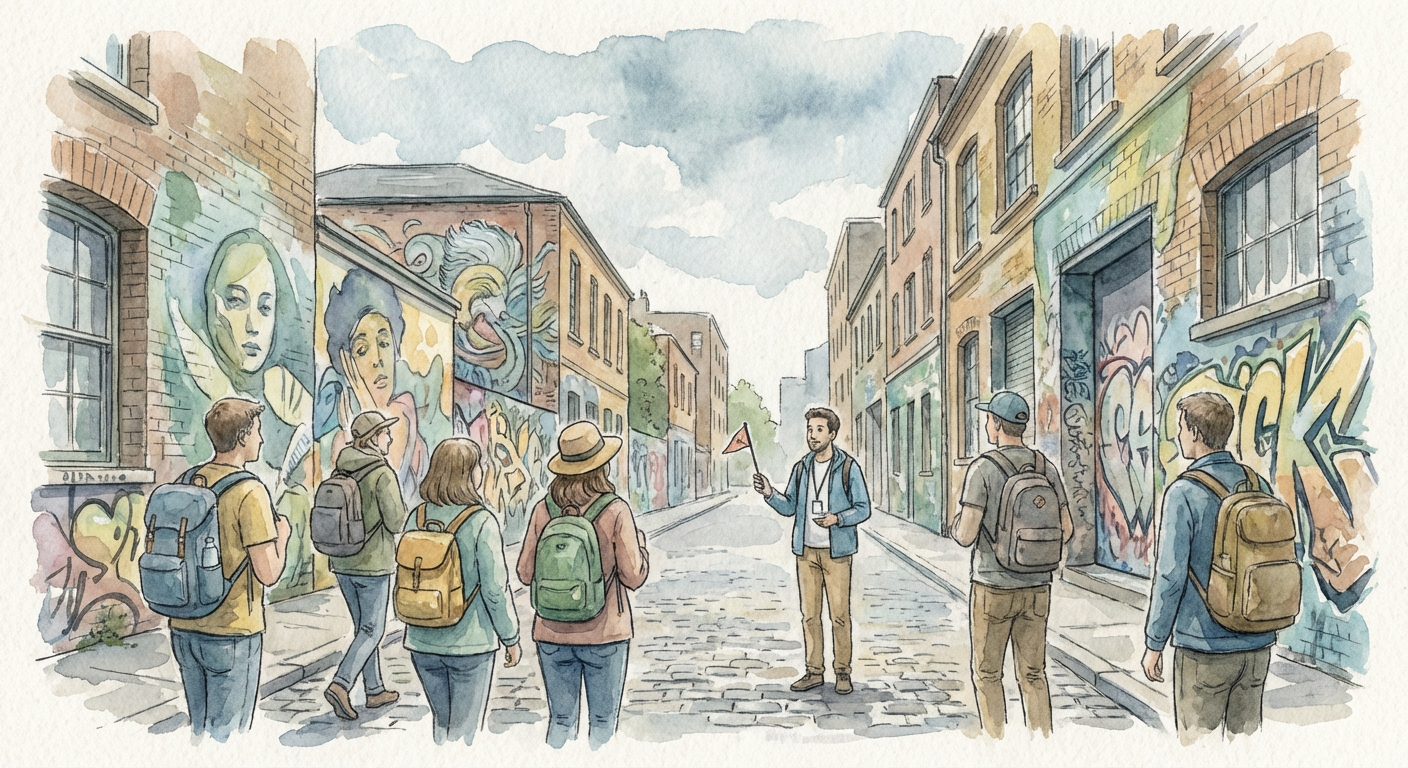
Walking tours focused on street art now rank among the top five tourist activities in major cities according to travel platforms. Guides lead groups through alleys that were once ignored or avoided. Former sites of creative rebellion become mandatory photo opportunities for visitors seeking authentic urban experiences.
This popularity creates some genuinely weird tensions. Tourists want transgression but demand safety. They want authenticity but prefer curated experiences. Tour operators have to balance genuine street culture with commercial viability. What you get is sanitized rebellion, transgression with training wheels.
Local artists face impossible choices. Participate in the tours and gain exposure but risk losing street cred. Avoid commercialization but miss economic opportunities. Some embrace the platform, others retreat deeper underground. The movement splits along commercial lines that didn’t exist when spray cans were the only currency.
Tourism’s influence goes way beyond individual artists to entire neighborhoods. Areas known for street art get hit with gentrification pressures. The art that originally reflected community identity becomes the catalyst for community displacement. Success plants the seeds of its own destruction.
Government Gatekeepers and Creative Negotiations
Municipal authorities are stuck with impossible equations. Invest millions in public art while simultaneously funding graffiti removal. Celebrate approved murals while prosecuting unauthorized ones. The line between vandalism and valuable culture often depends entirely on permission and context.
Some cities have developed more sophisticated approaches. Legal walls provide designated spaces for experimentation. Permit systems allow temporary installations. Community input processes make sure local voices influence what appears in their neighborhoods. These frameworks try to harness creative energy while maintaining civic order.
But something essential gets lost in translation. Bureaucratic approval processes completely contradict street art’s spontaneous, unauthorized nature. When rebellion requires permits, is it still rebellion? When transgression becomes policy, what replaces the original creative impulse?
The most successful programs actually acknowledge this tension instead of pretending it doesn’t exist. They create space for both sanctioned and unsanctioned work. They recognize that cities need controlled creativity and uncontrolled expression. Balance becomes the goal, not elimination.
Digital Frontiers and Collective Spaces
Technology pushes street art beyond static walls into dynamic, interactive territories. Digital projection mapping transforms buildings into moving canvases. Augmented reality layers virtual artworks over physical spaces. Artists working with Widewalls street art coverage increasingly experiment with these hybrid approaches.
Artist collectives simultaneously move in the opposite direction, reclaiming abandoned buildings as temporary gallery spaces. These groups create alternative circuits that parallel but don’t replace traditional institutions. They prove that artistic community can exist outside established systems while still reaching broader audiences.
The comparison between high-tech innovation and low-fi occupation shows different strategies for expanding artistic territory. Both approaches want to democratize art access. Both challenge institutional control over cultural production. But their methods and audiences often stay completely separate.
According to Street Art News, these parallel developments suggest street art continues evolving rather than getting replaced. Digital tools expand possibilities without killing the basic urge toward direct, immediate, physical mark-making.
Street art’s journey from underground rebellion to mainstream cultural force shows how creative movements adapt, split apart, and regenerate across changing contexts. Each transformation creates new tensions and possibilities, keeping the conversation between authority and artistic freedom perpetually unresolved. And maybe that’s exactly how it should be.
