
The Institutional Moment That Changed Everything
Late 2024 arrived with a declaration that felt inevitable and shocking in equal measure. The Museum of Modern Art, the same institution that once faced visceral pushback for canonizing photography and film, announced it would formally acquire AI-assisted artworks into its permanent collection. The backlash was immediate, predictable, and—let’s be honest—a bit tired. But here’s what the outrage actually revealed: we’re not really arguing about art. We’re arguing about labor, value, and who gets to decide what counts as creative work.
This wasn’t a sudden pivot. The groundwork had been laid years earlier. When Refik Anadol’s “Unsupervised” installation drew over 400,000 visitors during its 2023 run at MoMA, something shifted in the institutional calculus. Museums track attendance like galleries track sales. When a piece moves that many bodies through a space, when it generates that much conversation—whether reverent or furious—institutions notice. They also archive. And archiving leads to acquisition.
Follow the Money, Follow the Legitimacy
The art market has never been subtle about its priorities. Christie’s understood the assignment in March 2025 when it launched a dedicated “AI & New Media” auction category. The inaugural sale generated $8.2 million in a single evening. That’s not fringe collector behavior. That’s capital voting with its wallet. Meanwhile, global AI art sales hit $1.3 billion in 2024—a staggering 240 percent jump from 2022. These aren’t vanity metrics. They’re institutional inevitability wearing a price tag.
What MoMA is doing, then, isn’t pioneering so much as catching up to what the market already decided. Museums have always been late to the party. They canonize after consensus forms, after the real risk has been absorbed by galleries and collectors with less institutional weight to protect. MoMA’s mission has always been to contextualize the new within the continuum of modern thought. That’s exactly what’s happening here, whether we like the conclusion or not.
The 61 Percent That Can’t Be Ignored
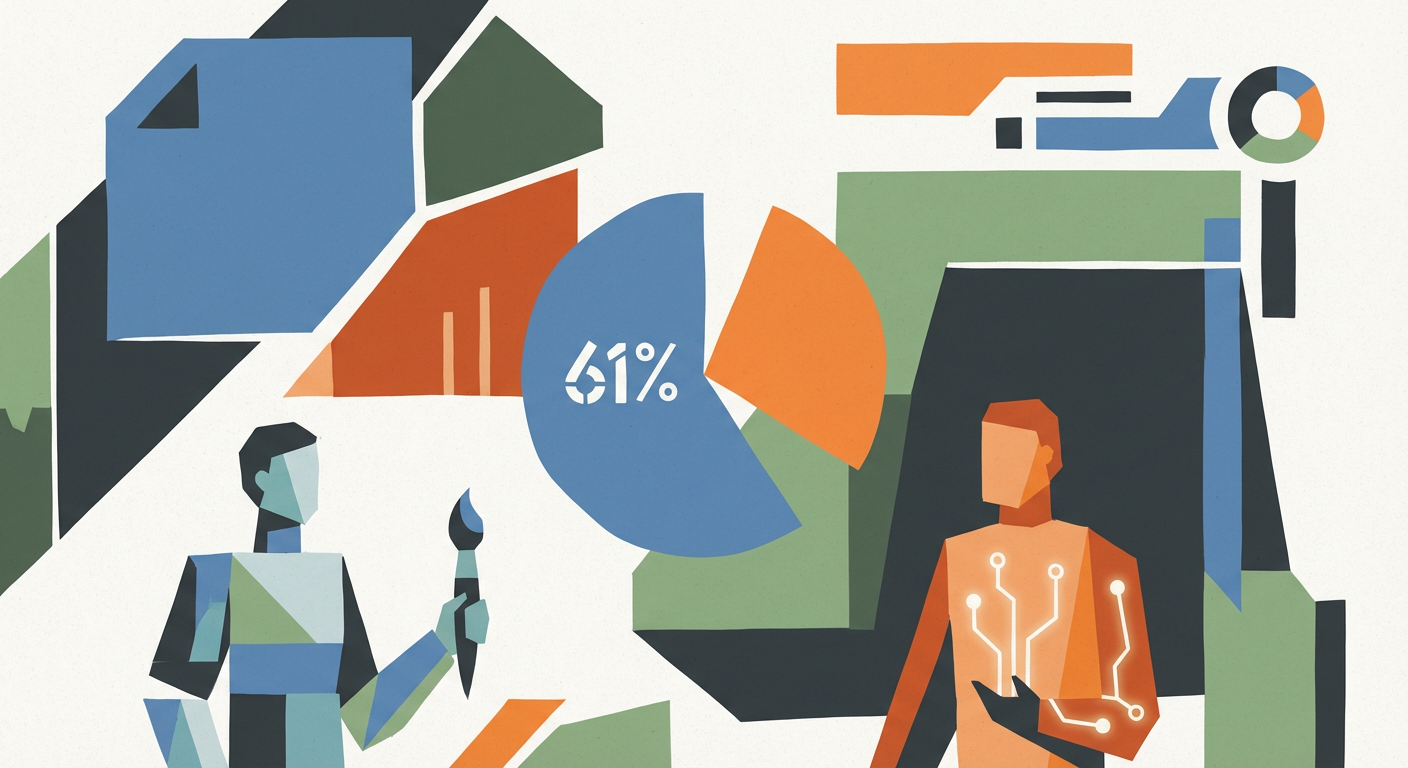
But let’s reckon with the legitimate fury. A 2025 survey by the College Art Association found that 61 percent of working studio artists believe AI art acquiring museum status undermines the labor and craft of human artmaking. That’s not a fringe complaint. That’s a supermajority of practicing artists, many of whom are already precarious, watching institutional legitimacy flow toward something generated by an algorithm. The grievance deserves examination, not dismissal.
Here’s where context matters. Artists have always resisted new tools and technologies. Photography didn’t destroy painting. It forced painting to become something else—more experimental, more abstract, more conceptually adventurous. Film didn’t kill theater. It changed what theater could be. The anxiety isn’t really about AI art itself. It’s about scarcity. When MoMA adds AI to its collection, it’s not removing a human artist from the wall. But it feels that way to people whose livelihoods depend on institutional favor being finite.
The actual betrayal in contemporary art isn’t MoMA acquiring algorithmic work. It’s that institutions have been systematically underfunding art education, artist residencies, and support systems for decades. It’s that the art market has become so dominated by wealth speculation that young artists can barely afford to live in the same cities where their work might be seen. MoMA’s AI acquisition is a symptom of larger failures, not the disease itself. You can check College Art Association resources on AI and art ethics for deeper dives into these arguments—they’re wrestling with this honestly.
What MoMA Is Actually Saying
When a museum of that scale acquires anything, it’s making a curatorial and historical argument. It’s saying: this belongs in the conversation about how humans make meaning. Whether we agree matters less than understanding what the statement implies. MoMA’s collection and acquisition philosophy has always reflected the institution’s conviction that modern art documents how consciousness evolves within technological systems. That includes photography, film, video, and digital media. AI is the next logical conversation.
The bold part isn’t that they acquired AI work. It’s that they’re doing it openly, courting this exact conversation, refusing to pretend the question has already been settled. Museums could have quietly slipped algorithmic pieces into their permanent collections across the next five years, buried them among other contemporary work, let time do the legitimating. Instead, MoMA announced it. They made the stakes visible. That’s the opposite of institutional cowardice.
The Actual Reckoning Ahead
What matters now isn’t whether MoMA’s decision was right or wrong. It’s what happens next. How does the museum contextualize these pieces? Who authored them? What human decisions shaped the parameters? What labor disappeared into the algorithm? These are the curatorial challenges that separate thoughtful acquisition from mere market chasing—the difference between an institution that’s paying attention and one that’s just following the hype.
The truth is less dramatic than either side wants it to be. MoMA isn’t betraying art by acquiring AI work. But they’d be betraying their actual mission if they acquired it thoughtlessly, without wrestling with precisely the concerns that 61 percent of artists are raising. The real question here isn’t deciding whether AI belongs in museums. It’s deciding what we ask from museums in an era when authorship, labor, and value have become genuinely unsettled.
Where do you land on this? Have you seen work that shifted your thinking on what AI can contribute to visual culture? The conversation is worth having with both rigor and generosity intact.
