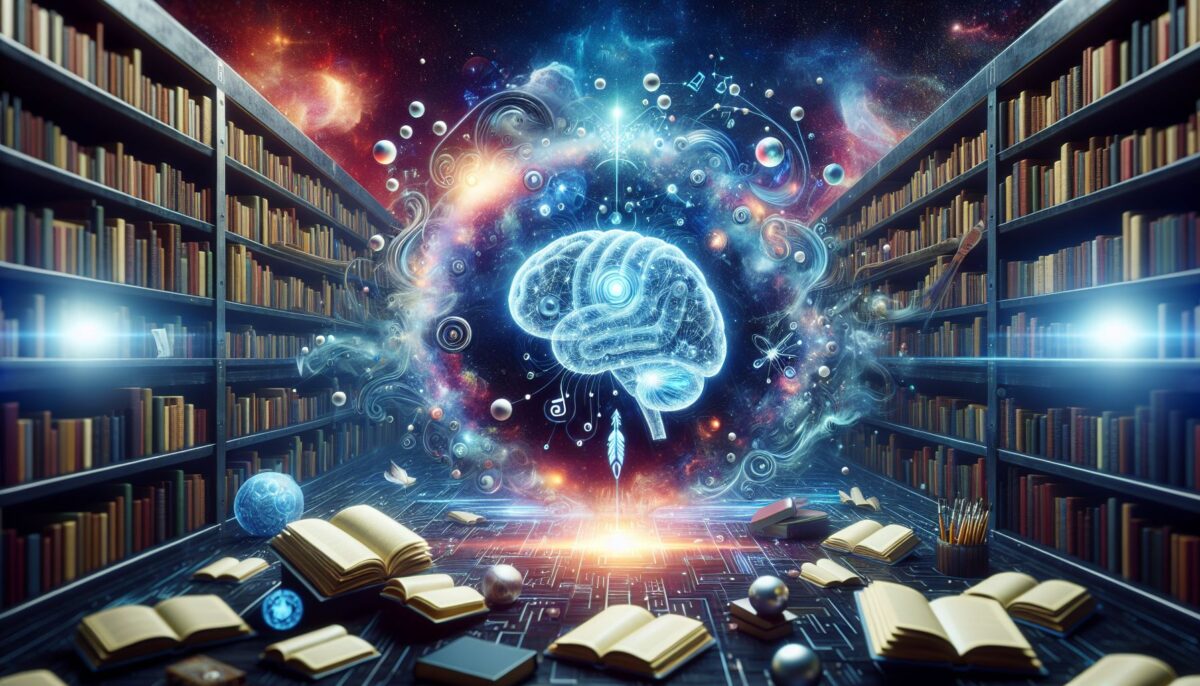
Ah, artificial intelligence! One moment it’s beating grandmasters at chess, and the next, it’s helping create a new generation of Picassos and Beat poets. What a wild ride it’s becoming. Today, we’re stepping into the kaleidoscopic world of AI in creative arts. And boy, is it exciting! Grab your artistic beret and your futuristic reading glasses (because, why not?), as we dive into how our silicon-based buddies are redefining creativity in ways that seem almost uncannily… human.
The Balance Between Silicon and Symphony
Remember when creativity was exclusively human turf? AI has been shaking things up, expanding the creative horizon to include a partnership between the digital and the artistic. Recently, tools like OpenAI’s DALL-E and Google’s DeepDream have been generating mesmerizing images straight out of a fever dream. And then there’s GPT-3, which sometimes seems to have swallowed a library of world literature, making writers wonder whether they should collaborate with or be wary of their new automated colleague.
The magic lies in AI’s ability to analyze massive data sets (think of it as gobbling up entire museums and libraries) to then produce compositions that either mimic human creativity or tread entirely new grounds. The appeal of this collaboration is like having a creative muse who can also do calculus at the speed of light. What could be better than finding beauty in precision?
Breaking Down the Creative Process
Let’s unpack what it takes for an AI to create. You feed it data. Lots of it. Styles, genres, historical contexts—it’s like giving a crash course to an over-enthusiastic college student who insists on double majoring in art and computer science. Once trained, AI uses this data to generate original content. For instance, a neural network might produce a symphony by learning from composers across centuries. It’s a bit like having Mozart and AI co-pilot the show.
Of course, the questions arise: is it truly original? Can an algorithm express emotions as humans do? It’s a fascinating debate, as some argue true creativity involves emotional depth and a subtlety that machines can’t grasp. Yet here we are, witnessing algorithms painting works that evoke emotions, blurring the lines between machine learning and human feeling.
Seeing Pixels in New Ways
Visual arts have seen a revolution thanks to deep learning algorithms. From traditional mediums like painting and photography, AI expands the canvas to interactive installations and generative designs. Need a futuristic cityscape for your video game? Platforms like Artbreeder let you design using AI-generated elements, making every pixel a point of possibility.
Take Google’s DeepDream, for instance. Those trippy, swirling visuals have inspired artists to use AI not just as a tool but as a co-creator. By amplifying patterns and tweaking neural connections, AI can create visuals that tickle the imagination and bend reality’s boundaries. It makes me wonder how long until AI imagines something we humans can’t even comprehend. Now that’s a hallmark of true creativity, or is it?
The Sounds of Tomorrow
AI in music has advanced to the point where it can compose symphonies with intriguing layers and complex rhythms. Amper Music, AIVA, and Google’s Magenta are leading the charge in creating scores that are compositionally complex and emotionally resonant. From ambient soundscapes to full-blown orchestral pieces, AI compositions blend the analytical prowess of machines with the emotive depth of classic compositions.
Musicians are increasingly viewing AI as a collaborator. Sure, your algorithm drummer might not have tales of endless band practice, but it compensates with an infinite rhythmic library. Here’s a fun thought experiment: might AI one day improvise jazz better than Coltrane ever did? Don your trilby, and let’s see where this interstellar jam session takes us!
Written by Robots
Enter the world of AI-scribed narratives. We’ve already seen successful forays into screenwriting and journalism, where data-driven storytelling allows AI to work on plot twists and character arcs. GPT-3, for instance, is transforming how we perceive written creativity. It’s not quite Philip K. Dick, but it’s getting eerily close.
The implications here are vast. Will AI-authored novels become bestsellers? Will they even need a human editor? It’s a curious timeframe we’re heading into when AI might not only tell the story but be the story. Imagine a world where each AI has a personality imprinting its creator, each influencing narratives in wildly different ways.
A Look Into the Crystal Ball
So, what does the future hold for AI in the creative arts? There’s no doubt AI will continue to impact how we think and create. But envisioning a world where every creation is a symbiotic fusion of human and AI genius feels more like an eventuality than a wild concept.
Sure, there are inevitable challenges: the ethics of authorship, concerns of losing the human touch, and the looming question of intellectual property. Nevertheless, collaborations between artists and AI will push the boundaries of the conceivable, producing innovative work that neither man nor machine could achieve alone.
Whether you call it a renaissance or a revolution, one thing is clear. AI isn’t here to replace human creativity, but it’s definitely here to reshape it. Much like a careful dance, as long as we maintain the delicate balance, we’ll keep discovering new possibilities in this uncharted artistic frontier.
So there you have it, folks. As we paint, compose, and write our future with AI by our side, we find ourselves in a grand cosmic collaboration. And just maybe, the best is yet to come.
